
Articles
Why group harmony matters: guide to stress-free social plans
Discover why group harmony is the key to stress-free social planning. Learn how to build it, spot warning signs, and keep your friend group connected and thriving.

Why group harmony matters: guide to stress-free social plans

TL;DR:
- Group harmony creates strong connections, improving communication, cooperation, and mental health.
- Maintaining shared rituals, open communication, and addressing conflicts fosters lasting cohesion.
- Excessive harmony may lead to groupthink, suppressing honest opinions and damaging relationships.
Keeping a friend group together sounds simple until it isn't. Plans fall apart, chats go quiet, and somehow even the most excited crew ends up canceling. Most people blame busy schedules or bad timing, but research points to something deeper: group harmony. When your friend group lacks that underlying sense of connection and alignment, even the best-planned hangout can feel awkward or forced. This guide breaks down what group harmony actually is, why it matters more than you might think, and how you can build it so your social life runs smoother, feels more natural, and creates memories worth keeping.
Table of Contents
- What is group harmony and why does it matter?
- How group harmony creates better connections and easier plans
- The hidden mechanics: What really builds or breaks group harmony
- The balance: When too much harmony backfires
- Our take: Why group harmony is the real social hack for Gen Z and young adults
- Make group harmony easier with Groop Labs
- Frequently asked questions
Key Takeaways
| Point | Details |
|---|---|
| Harmony drives group success | Groups with strong harmony communicate better, make decisions smoothly, and enjoy more satisfying experiences. |
| Shared activities are key | Regular rituals and activities build bonds and help revive friendships after life changes. |
| Balance is essential | While harmony is vital, too much can hurt if it stifles honest conversations or diversity of ideas. |
| Small habits add up | Little actions like including everyone or running a group chat strengthen long-term connections. |
What is group harmony and why does it matter?
Group harmony is the feeling that everyone in your crew is on the same page. It's not about agreeing on everything or never having conflict. It's about cohesion, the sense that people genuinely support each other, communicate openly, and feel like they belong. When that foundation is solid, everything else gets easier.
Without harmony, even small things become friction points. Someone suggests a plan and gets silence. One person always decides for everyone. Inside jokes fade. Eventually, people stop trying. These are not just personality clashes. They are signs of a group that has lost its alignment.
"Group harmony, through cohesion and alignment, fosters better communication, cooperation, member satisfaction, and task performance by reducing free-riding and enhancing mutual support." — Group Cohesion Research
That applies just as much to friend groups as it does to work teams. When your squad has real cohesion, people show up, contribute ideas, and actually follow through on plans. When it's missing, you get the classic "sounds good" with zero follow-up.
Research also shows that group harmony links to better self-esteem and mental health outcomes for young adults and teens. Being part of a connected group isn't just fun. It's genuinely good for you.
Here's a quick way to tell where your group stands:
Signs of a harmonious friend group:
- Plans get made and actually happen
- Everyone's opinion gets heard
- Disagreements get resolved without drama
- People check in on each other between hangouts
- New ideas are welcomed, not shut down
Signs of a chaotic or disconnected group:
- Plans get suggested but never confirmed
- One or two people carry all the effort
- Tension lingers after disagreements
- The group chat goes quiet for weeks
- People feel left out or overlooked
Understanding group chat basics is a great starting point, but harmony goes deeper than how you communicate. It's about how your group feels to be part of.
How group harmony creates better connections and easier plans
Once you understand what harmony is, the next question is: what does it actually change? The short answer is almost everything, especially when it comes to making plans work.
Cohesive groups outperform non-cohesive ones because of motivation, commitment, and communication. In friend group terms, that means people actually respond to messages, show up on time, and put in effort to make things happen. The logistics get easier because the emotional foundation is already there.
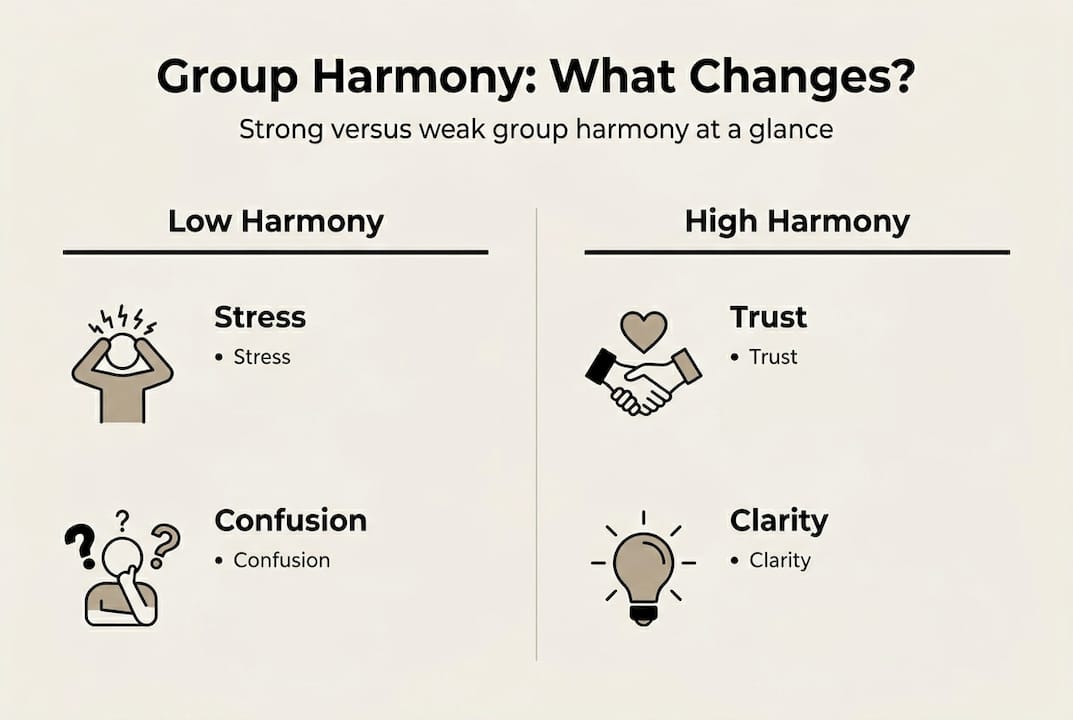
Shared activities play a big role in building that foundation. Game nights, cooking together, or even a group walk can create the kind of low-pressure bonding that strengthens trust over time. And the timing matters more than you think: 67% of adults lose friends after major life changes, but making new memories together can genuinely revive those fading bonds.
Impact of group harmony on real outcomes:
| Outcome | Low harmony group | High harmony group |
|---|---|---|
| Communication quality | Frequent misunderstandings | Clear, open exchanges |
| Meetup success rate | Plans often canceled | Plans follow through |
| Conflict resolution | Tension lingers | Issues resolved quickly |
| Group satisfaction | People disengage | Everyone feels included |
| New member inclusion | Cliques form | Welcoming and flexible |
The table makes it clear: harmony is not just a nice-to-have. It's the difference between a group that thrives and one that slowly fades.
Following group chat best practices helps, but the real magic happens when the group itself is aligned. Here's a simple process to get there:
- Listen actively. When someone shares an idea, acknowledge it before jumping to your own.
- Set shared goals. Agree on what the group is about, whether that's weekly hangouts, monthly adventures, or just staying in touch.
- Keep things fair. Rotate who picks the activity or location so no one person always leads.
- Celebrate small wins. Acknowledge when a plan actually worked out. It reinforces positive momentum.
- Stay consistent. Regular touchpoints, even brief ones, keep the connection alive between bigger events.
Groups that are thriving in group chats tend to have these habits baked in. And when group scheduling challenges come up, a harmonious group navigates them without the usual stress.
The hidden mechanics: What really builds or breaks group harmony
Harmony doesn't just happen. There are real forces at work beneath the surface, and understanding them gives you a practical edge.
One of the biggest factors is similarity. Groups with shared interests, humor, or values find it easier to connect. That doesn't mean everyone needs to be identical, but having some common ground gives the group a natural starting point. Smaller groups also tend to be more cohesive. It's easier to feel seen in a group of five than in a group of twenty.
Facing challenges together is another powerful builder. Whether it's navigating a tough trip or just figuring out a complicated dinner reservation, shared problem-solving creates bonds. Harmony grows through similarity, small group size, shared success, and even facing external threats together.

Then there's synchrony. This is the science of people getting in rhythm with each other, emotionally and physically. Laughing at the same moment, moving together in a game, or finishing each other's sentences are all forms of synchrony. Research on interbrain synchrony shows that moral alignment and collective decision-making emerge when group members get in sync, which makes it easier for everyone to feel like they're moving in the same direction.
Strong harmony vs. fragile harmony:
| Feature | Strong harmony | Fragile harmony |
|---|---|---|
| Group size | Small to medium (3 to 8) | Large or undefined |
| Shared history | Rich with rituals and in-jokes | Mostly surface-level |
| Communication style | Open and two-way | One-sided or passive |
| Conflict handling | Addressed directly | Avoided or ignored |
| Decision-making | Collaborative | Dominated by one person |
In-jokes, recurring traditions, and group rituals are more powerful than they seem. They signal belonging and create a shared identity that keeps people coming back.
Pro Tip: Pick one small ritual your group can repeat, like a monthly movie night or a specific playlist for road trips. Repeated shared experiences are one of the fastest ways to build lasting group harmony. Check out chat planning tips to make those rituals easier to organize.
The balance: When too much harmony backfires
Here's the part most people skip: harmony can actually work against you if it goes too far. A group that values peace above everything else can start to suppress honest opinions, and that's where things get unhealthy.
This is called groupthink, where the desire to keep things smooth leads everyone to agree even when they shouldn't. Plans that nobody actually likes get made because no one wants to be the one to speak up. Excessive cohesion leads to conformity pressure, suppressed dissent, and power imbalances that can quietly damage relationships.
"When harmony becomes the priority over honesty, the group stops growing. Real connection requires the safety to disagree."
Research also shows that all conflict types negatively relate to group performance, including task conflict, which is often assumed to be helpful. The takeaway isn't that conflict is good. It's that suppressing it entirely is worse.
Watch for these warning signs in your own group:
- No one ever disagrees on plans, even when the options aren't great
- The same person always decides and others just go along
- Certain topics feel off-limits even among close friends
- New people rarely get included because the group feels closed off
- Anyone who speaks up gets met with silence or subtle pushback
Pro Tip: Healthy harmony means people feel safe enough to say "actually, I'd rather do something else." Build that culture by genuinely welcoming different opinions and making it normal to push back respectfully. Understanding avoiding group communication issues can help you spot these patterns early.
The goal isn't a conflict-free group. It's a group where people feel secure enough to be honest, and where that honesty makes the group stronger.
Our take: Why group harmony is the real social hack for Gen Z and young adults
Here's something we've noticed at Groop Labs: most people try to fix their social life by finding a better app, a better event, or a better time to meet. But the real problem is almost never logistics. It's the emotional foundation underneath.
You can have the best scheduling tool in the world and still end up with a group chat full of "sounds great!" and zero follow-through. That happens when harmony is missing. No tool fixes that.
What actually works is intentional connection. Small, repeated rituals. Checking in without an agenda. Making space for people to be honest about what they want. These habits build the kind of group that doesn't need a perfect plan because the connection itself is the point.
We think group chat etiquette tips and smart scheduling matter, but they're support structures for something more important: a group that genuinely wants to show up for each other. Prioritize that, and the logistics take care of themselves.
Make group harmony easier with Groop Labs
Building harmony takes intention, and having the right tools makes it a lot less stressful. That's exactly what Groop Labs was built for.

Groooop takes the back-and-forth chaos out of group planning so your crew can focus on actually connecting. Instead of long polls and confusing threads, Grooop lines up everyone's availability, surfaces conflicts early, and gives your group simple, clear choices to work with. Less friction means more energy left for the good stuff. Whether you're organizing a weekly hangout or a spontaneous outing, Groop Labs keeps things light and pressure-free so your group's vibe stays exactly where it should be.
Frequently asked questions
What is group harmony in a group of friends?
Group harmony means everyone feels included, supported, and free to share ideas, making plans and interactions smooth and enjoyable. Group cohesion research confirms that this alignment directly improves communication, cooperation, and satisfaction.
How can group harmony help with stress-free social planning?
Harmony reduces misunderstandings and encourages participation, so organizing meetups or trips happens with less drama and more fun. When cohesion and alignment are present, group activities simply work better.
What can damage group harmony the fastest?
Ignoring disagreements, letting one person dominate, or never changing routines can cause issues like groupthink or make people feel left out. Excessive cohesion and power disparities are among the fastest ways to break trust in a group.
Does group harmony mean everyone agrees all the time?
No. Healthy group harmony welcomes honest opinions and occasional disagreements as long as there is mutual respect. Without that balance, groupthink and suppressed disagreement tend to take over.
How do you improve group harmony easily?
Start with regular shared activities, check-ins, and small rituals like game nights or group chats to boost connection. Shared activities like games, cooking, or even a group walk build bonds and reduce tension over time.
Recommended
- How to organize group plans for stress-free hangouts | Groop Blog
- How to simplify group planning: stress-free steps | Groop Blog
- Friend Group Coordination Explained: Stress-Free Planning | Groop Blog
- Group planning trends for young adults: easy coordination | Groop Blog
- Why organize music gatherings: growth, community, skills
- How to Plan a Camping Trip for Stress-Free Adventure