
Articles
Group Communication Challenges – Why Coordination Fails
Group communication challenges explained, including types, common pitfalls, and real-world impacts for friend groups planning events and activities.

Group Communication Challenges – Why Coordination Fails

Trying to make group plans with friends can turn into chaos fast, especially when messages go unseen or mixed signals lead to last-minute surprises. In cities from New York to Tokyo, young adults juggle busy schedules, different apps, and competing priorities, making smooth coordination feel impossible. The reality is that group communication now means managing not just texts, but response times, digital habits, and conflicting interests—challenges that can leave social plans stalled before they even start. Here, discover practical ways to spot and solve these modern problems so your hangouts happen with less stress.
Table of Contents
- Defining Group Communication Challenges Today
- Types of Communication Gaps in Groups
- Common Pitfalls in Social Planning
- How Digital Solutions Address Challenges
- Avoiding Misunderstandings and Social Friction
Key Takeaways
| Point | Details |
|---|---|
| Understanding Communication Gaps | Identify specific gaps like information visibility, communication norms, goal misalignment, and decision clarity that impact group coordination. |
| Use Digital Solutions | Employ tools designed for group coordination that streamline decision-making and enhance information flow. |
| Proactive Communication | Foster an environment where members can clarify misunderstandings early to maintain a positive group dynamic. |
| Acknowledge Individual Styles | Recognize that different members have varying communication styles and needs, and tailor planning accordingly to minimize friction. |
Defining Group Communication Challenges Today
Group communication happens when you and your friends exchange messages, make decisions, and coordinate plans together. It sounds simple enough, but the reality is messier. Modern group communication involves far more complexity than just texting a group chat. It includes managing different communication platforms, working across time zones, handling conflicting schedules, and keeping everyone in sync when people have competing priorities.
The core challenge today stems from how groups function in our digital world. Group communication involves interaction among small groups collaborating to make decisions, share ideas, or plan projects. When you're trying to organize a hangout with your crew, you're dealing with more than just logistics. You're managing different personality types, varying levels of responsiveness, conflicting preferences, and the friction that happens when someone doesn't see the message or forgets to respond. Add in the fact that people use different apps, check their phones at different times, and have unpredictable schedules, and you start to see why coordination falls apart so easily.
What makes this even harder is that group dynamics involve decision-making, conflict resolution, and diverse member backgrounds all happening simultaneously. When you're planning a group activity, you're not just picking a time and place. You're navigating whose availability matters most, who has the strongest opinions about what to do, whether someone feels left out, and how to keep the vibe positive when plans change. Traditional group chats create endless threads where decisions get lost, information repeats itself, and people feel overwhelmed by notifications. The back-and-forth becomes chaotic because there's no clear structure for who needs to respond, by when, or what actually counts as a final decision.
Young adults managing casual friend groups face a specific set of problems. You might have between 4 and 12 people you regularly hang out with, each checking their phones sporadically, each with jobs, classes, or other commitments that shift week to week. One person might respond immediately while another takes 18 hours. Someone will inevitably forget they committed to something. Plans will change, and you'll need to renegotiate. The friction isn't about communication itself—it's about the lack of structure around what needs to happen next and who's responsible for making sure it does.
Pro tip: When you notice communication breaking down in your group, the problem usually isn't people being flaky—it's that your coordination method doesn't match how your group actually operates. Address the structure first, not the people.
Types of Communication Gaps in Groups
Communication gaps don't show up as one big problem. They emerge in different ways depending on the situation, the people involved, and how your group is organized. Understanding these distinct types helps you spot what's actually going wrong when plans fall apart or messages get lost. The gaps that destroy group coordination fall into several recognizable patterns that affect almost every friend group at some point.
The first major gap is information visibility. Someone sends a message in the group chat, but not everyone sees it. Maybe the chat got buried under other notifications. Maybe one person left the chat by accident. Maybe the message was posted at 2 AM and half the group doesn't check their phones until morning. Communication gaps arise from delayed response times, difficulty identifying the right contacts, and inconsistent dissemination of information, all creating friction in group coordination. When information doesn't reach everyone at the same time, decisions get made with incomplete input, people feel excluded, and plans change without proper notice.

Another critical gap is different communication norms and expectations. Your extroverted friend responds to messages within minutes and expects quick replies. Your introverted friend checks messages once a day and finds constant back-and-forth exhausting. One person uses emojis and casual language; another prefers direct, formal communication. Gaps in communication norms and unequal representation across regions create misunderstandings about urgency, tone, and commitment. When someone doesn't respond immediately, does that mean they're not interested, or are they just busy? When someone proposes five different meeting times, are they being thorough or overwhelming the group? These unspoken assumptions lead to hurt feelings and missed connections.
Then there's the goal misalignment gap. Your goal is to find a time everyone can make it. Someone else just wants to grab drinks with whoever shows up. Another person is thinking about whether they can afford to go. Idiosyncratic goals, interests, and incentives between different members create friction because people aren't trying to solve the same problem. One person sees group planning as a serious commitment; another treats it casually. These competing priorities mean that even when communication is clear, coordination still fails because the group isn't aligned on what they're actually trying to accomplish.
The final gap worth recognizing is the decision clarity gap. The group chats for an hour about going out, someone suggests Friday, nobody explicitly agrees or disagrees, and then half the group shows up expecting something different. Was Friday actually the plan? Who was supposed to confirm the details? No one knows. This gap exists because there's no clear moment where a decision actually becomes final, no acknowledgment of who committed to what, and no simple way to confirm that everyone understands what's happening next.
Pro tip: Identify which gap is breaking your group's coordination—visibility, norms, goals, or clarity—then address that specific problem rather than trying to fix "communication" as a whole.
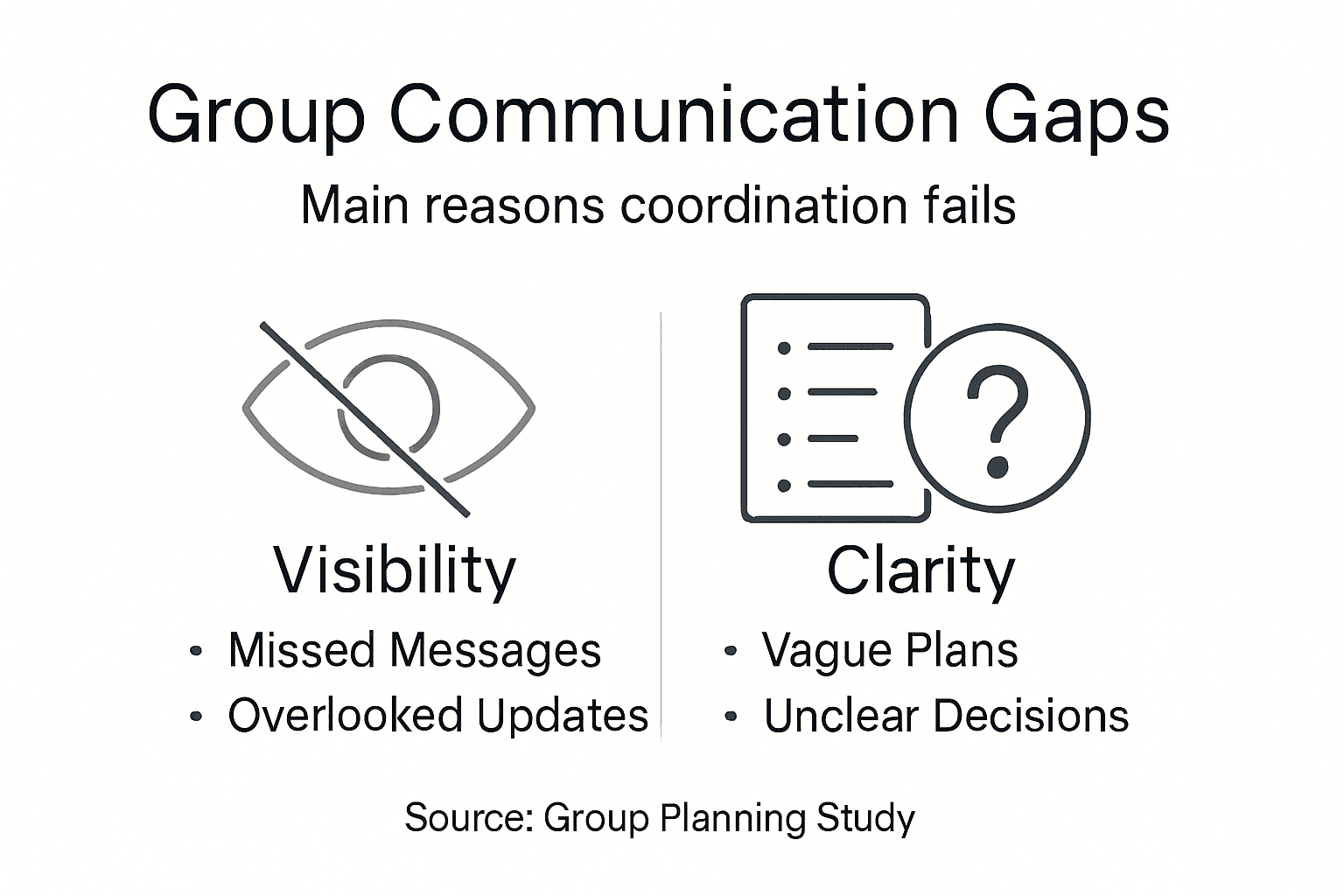
Here's a summary comparing the main types of group communication gaps:
| Gap Type | Typical Cause | Key Impact on Group | Example Scenario |
|---|---|---|---|
| Information Visibility | Messages missed or buried | Decisions made with missing input | Someone never sees the plan |
| Communication Norms | Differing response styles or tone | Misunderstandings escalate | One replies instantly, another hours later |
| Goal Misalignment | Conflicting priorities or expectations | Plans fragment, dissatisfaction | Some value fun, others logistics |
| Decision Clarity | No clear closure on choices | Uncertainty and wrong assumptions | Unclear if Friday was final |
Common Pitfalls in Social Planning
When you're trying to coordinate a group hangout, certain mistakes happen repeatedly. These aren't random failures. They're predictable pitfalls that catch almost every friend group at some point. Recognizing them before they derail your plans makes coordination exponentially easier. The most dangerous pitfall is assuming everyone shares the same understanding of what's being planned. One person thinks you're all meeting at 7 PM sharp. Another thinks 7 PM is just a rough target and showing up at 7:45 is totally fine. A third person thought you were meeting at the coffee shop downtown, while the original suggester meant the one near the park. Nobody explicitly confirmed these details, so everyone walks away frustrated.
The second major pitfall is misjudging response timing. Social planning involves failing to recognize communal understandings and misjudging the timing of responses, which causes coordination failures at multiple levels. You send a message asking for availability at 2 PM on a Tuesday afternoon. Your friend doesn't see it until 11 PM that night and responds then. By that time, you've already made decisions based on incomplete information. You thought they weren't interested. They thought they were helping by providing input. The timing mismatch created a false narrative about commitment and interest. This happens constantly in group chats where people operate on completely different schedules, yet there's no system acknowledging when responses actually matter and when they don't.
Another critical pitfall is overcomplicating the decision process. You're trying to find a time that works for eight people. So you create a poll with 15 different time options across three weeks. You ask people to rank their preferences. You send follow-up messages when people don't respond. You create secondary polls narrowing down the top choices. Meanwhile, half the group has given up and stopped paying attention. The planning process becomes more exhausting than the actual hangout. What you really needed was a structured way to quickly surface who's available when and make a decision without endless back-and-forth. Instead, you created a coordination nightmare that relies on poorly structured planning processes and inadequate tools.
The final pitfall is ignoring conflicting priorities. Someone says they'll come, but they also mentioned they might have to work late. Another person is interested but can't afford to go out this week. Someone else is dealing with family stuff and probably can't make it but won't know until the last minute. Instead of acknowledging these real obstacles upfront, you pretend everything's a yes or no, and then people flake because their actual situation changed. The planning fails not because communication was bad, but because you didn't build in space for the messiness of real life.
Pro tip: Stop treating every response as equal. Create a moment where decisions officially close, acknowledge who's actually committed, and confirm the specific details with those people only, rather than cycling through endless group-wide negotiations.
How Digital Solutions Address Challenges
The reality is that group coordination has gotten harder, not easier, despite having more communication tools than ever. Your group chat works for casual banter, but it fails spectacularly at making actual decisions. Email is too formal and slow. Phone calls require synchronizing everyone's schedule just to discuss when to meet. What you need is a tool specifically designed for the coordination problem itself. Digital solutions that focus on the right problem can transform how your group functions. Digital communication technologies have enabled geographic flexibility and seamless information exchange, removing barriers that used to make group planning impossible.
The best solutions address the specific gaps we identified earlier. For the information visibility problem, digital tools create a single location where plans live, so nobody can claim they didn't see it. For the timing mismatch problem, specialized platforms separate the planning phase from the commitment phase. You surface availability first, then make the decision without waiting for everyone to be online simultaneously. For goal misalignment, good tools make implicit assumptions explicit by asking people to confirm specifics like time, location, and activity level. For decision clarity, the best platforms create a clear moment where a decision officially closes and everyone knows who committed to what.
Digital solutions reshape information transfer by creating parallel communication spaces and enabling new interaction forms that remove the chaos of traditional group chats. Instead of 47 messages about whether Friday or Saturday works better, a coordinated planning tool shows availability in one visual format. Instead of someone responding at midnight and derailing a decision that was already made, the tool establishes when input matters and when it doesn't. Instead of assuming people will remember the coffee shop location from three days ago, the platform confirms details with people who actually committed.
What separates effective tools from the noise is whether they reduce friction or just move it around. A tool that requires everyone to download an app, create an account, verify their email, and log in every time defeats the purpose. A tool that works inside the messaging platform you're already using, that takes 30 seconds to set up a plan, and that actually closes decisions instead of creating endless negotiation loops addresses the real problem. The goal isn't to add another app to your phone. The goal is to make planning so effortless that coordinating a group hangout feels natural instead of like a logistical nightmare.
Pro tip: Choose a tool that lives where your group already communicates, not one that requires learning a new platform or context-switching between apps.
To help you choose the right digital planning tool, consider these differentiators:
| Feature Focus | Friction Reduction Approach | Real-World Benefit |
|---|---|---|
| Native integration | Works inside existing group chats | No need to download new apps |
| Structured decision phase | Separates voting from commitment | Reduces endless negotiations |
| Explicit summary prompts | Confirms time, place, participants | Fewer mix-ups, more clarity |
| Visual availability tools | Displays group schedules at a glance | Finds consensus efficiently |
Avoiding Misunderstandings and Social Friction
Misunderstandings are inevitable when coordinating a group. The difference between a functional group and a fractured one isn't that misunderstandings never happen. It's that functional groups catch them early and resolve them before they poison the vibe. The key is creating an environment where people feel safe clarifying things without embarrassment and where assumptions get surfaced before they become conflict. Effective communication climate fosters psychological safety and openness to dissent, which prevents social tension and promotes genuine collaboration. When someone can say, "Wait, I thought we were meeting at 6, not 7," without it becoming a whole thing, you've created a culture where coordination actually works.
The most common source of friction in group planning is operating on different implicit assumptions. Someone assumes a "casual hangout" means showing up in whatever you're wearing. Someone else thinks it means getting dressed up. One person assumes casual means splitting the bill. Another person thinks the person who suggested it is treating. Nobody asked these questions upfront, so people arrive frustrated. Preventative strategies include acknowledging potential misinterpretations proactively and fostering compassionate dialogue, which minimizes friction before it builds. The solution isn't to have one long explanation at the start. It's to make confirming the details feel like a natural part of the planning process, not an interrogation. "Just to confirm, we're thinking casual Thursday night, everyone covers their own food, right?" takes three seconds and prevents 20 minutes of awkward misalignment.
Another source of friction emerges when people interpret tone through text. Your friend says "cool, I'll be there" and you interpret it as lukewarm commitment. Actually, they were just being quick because they were busy. They show up expecting everyone to be hyped, and instead they find you acting weird because you thought they didn't really want to come. Text strips away nonverbal cues that would make intentions obvious in person. What feels urgent to you might feel pushy to someone else. What feels casual to someone else might feel dismissive to you. None of this is anyone's fault. It's just the reality of coordinating through screens. The fix isn't to overthink every message. It's to confirm the important stuff directly.
The deeper layer is that different people have different communication styles and comfort levels with planning. Some people need lots of details and advance notice to feel secure. Others feel overwhelmed by too much information and just want to know the essentials. Some people view planning conversations as fun social bonding. Others see them as chores. Some people change their minds easily if something better comes up. Others view commitments as sacred. None of these styles is wrong, but they create friction when they clash without acknowledgment. Building in space for these differences means asking directly: "Do you want to know every detail, or just the time and place?" "How much notice do you need before something starts?" "Is this tentative or locked in?" These conversations feel awkward but prevent endless silent resentment.
Pro tip: Before finalizing plans, confirm the three things most likely to cause friction: the exact time, the specific location, and what commitment level people are making (definitely coming, probably coming, or tentative).
Simplify Your Group Coordination with Groop
The article highlights common group communication challenges like information visibility gaps, decision clarity issues, and mismatched communication norms that make organizing plans frustrating and chaotic. If your friend group struggles with endless back-and-forth or unclear commitments, you are not alone. Groop is designed exactly to solve these pain points by streamlining social planning for casual groups. It helps avoid the pitfalls of confusing group chats by offering a lightweight, pressure-free scheduling tool that lines up availability, surfaces conflicts, and closes decisions clearly.
Ready to transform the way your group coordinates and reduce planning stress? Discover how Groop keeps your plans simple and your group vibe intact with features tailored to your social dynamics. Don’t wait until another plan falls apart from miscommunication. Visit Groop now to start organizing hassle-free hangouts and experience smoother decision-making today. Learn more about how Groop addresses key issues in digital group communication and experience stress-free social planning at your fingertips.
Frequently Asked Questions
What are the main challenges in group communication?
Group communication challenges include information visibility issues, varying communication norms, goal misalignment, and unclear decision-making processes. These factors can lead to misunderstandings and coordination failures among group members.
How can I improve coordination in my group?
To improve coordination, establish a clear structure for communication, use digital tools that enhance visibility and decision-making, and confirm important details directly to prevent misunderstandings.
What role do digital tools play in resolving communication challenges?
Digital tools can streamline group communication by providing a centralized location for plans, separating input phases from commitment phases, and confirming details with all group members, thus reducing coordination friction.
Why do misunderstandings occur frequently in group planning?
Misunderstandings often happen due to differing implicit assumptions about timing, commitment, and expectations. Without clear communication and confirmation of details, group members may have conflicting interpretations, leading to frustration.
Recommended
- Managing Hangout Logistics: Making Group Plans Stress-Free | Groop Blog
- Why Plans Die In The Group Chat | Groop Blog
- Join Group Chats: The Essential Guide for 2026 | Groop Blog
- Groop Blog
- Understanding Group Availability: A Guide to Coordination - WhenNOT Blog
- Understanding Team Collaboration Guide – Optio Station: Best Project Management App for Prioritization