
Articles
Why Plans Die In The Group Chat
Group chats have become where most plans begin, yet a surprising number never turn into real meetups. This article looks at why that happens, and what actually helps plans survive.

Group chats are where most plans begin.
Someone suggests grabbing a drink, seeing a film, or meeting up this weekend. A few people reply. Reactions roll in. For a moment, it feels like something is happening.
And then, quietly, it isn't.
No one cancels. No one says no. The conversation just moves on. By the time anyone notices, the moment has passed.
This happens so often that it feels normal. But it is not because people are flaky or uninterested. A lot of the time, everyone genuinely wants to meet.
The problem is the space we use to plan.
Group chats are easy to start, hard to finish
Messaging apps are great at one thing: conversation. They are fast, informal, and low effort. That is exactly why we use them to make plans in the first place.
But those same qualities make them surprisingly fragile environments for coordination.
Messages arrive at different times. Key details get buried. Suggestions pile up without ever narrowing down. Some people reply straight away, others hours later, others not at all. It becomes harder to tell what is decided and what is still open.
So people hesitate. They wait to see what others do. They skim instead of engaging. Eventually, the group drifts.
Nothing has gone wrong socially. The system just never helped the group converge.
No one wants to be the organiser
There is also a quieter dynamic at play.
In group chats, responsibility is shared by everyone, which often means owned by no one. Stepping in to push for a decision can feel awkward, bossy, or like you are taking on a role you did not ask for.
Saying “maybe” feels safer than saying no. Letting a plan fade feels easier than being the one to end it.
So groups stay polite, flexible, and stuck.
From the outside, it looks like indecision. From the inside, it feels like avoiding unnecessary pressure.
What about calendars?
On paper, calendars seem like the obvious fix. But in practice, they rarely fit how casual plans work.
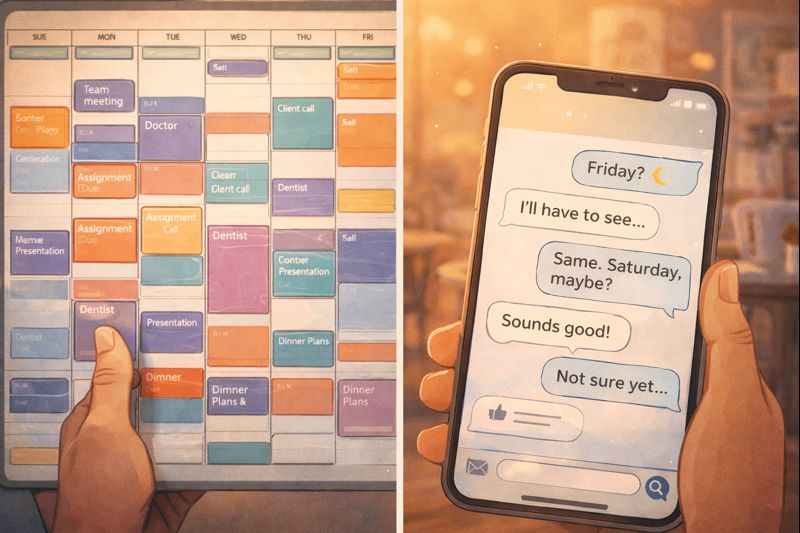
For many people, especially younger groups, calendars are associated with work, classes, deadlines, and obligations. Putting a casual hangout into a formal scheduling tool can feel heavy, even performative.
So social plans stay in chat, where they feel lighter and more optional, but also more fragile.
The gap between intent and outcome
Most failed plans are not a lack of interest problem. They are a coordination problem.
People want to meet. They just do not want to negotiate availability, manage social dynamics, or chase closure in a noisy space. The effort feels disproportionate to the plan itself.
Over time, that friction adds up. Groups stop trying as often. Invitations become vaguer. Expectations lower.
Not because people care less, but because planning feels like work.
What actually helps plans survive
Plans are more likely to happen when coordination becomes easier than avoidance.
That does not mean forcing decisions, formalising everything, or adding pressure. It means reducing the invisible work that sits between “we should do this” and actually picking a time.
It means helping groups see patterns without calling them out. Narrowing options without taking control. Letting people stay informal while the logistics quietly settle in the background.
How does Groop help?
Groop exists to sit in that space.
It handles the parts of planning that tend to stall conversations, without turning social plans into tasks. It notices availability without demanding replies. It surfaces clarity without pushing for closure.
Nothing is decided for the group. People stay in control. The conversation stays human.
The difference is that plans no longer rely on someone stepping up, scrolling back, or doing mental maths on everyone's schedules.
Lighter planning, same people
When planning feels lighter, groups do it more often. When the effort drops, follow through improves naturally.
Sometimes plans still do not work out. That is fine too.
But when they do, it should feel simple. Like nothing special happened at all.
And that is kind of the point.