
Articles
Group Scheduling Challenges – Navigating Social Planning Chaos
Group scheduling challenges explained for college students: learn types of coordination issues, how scheduling tools work, common pitfalls, and practical solutions.

Group Scheduling Challenges – Navigating Social Planning Chaos

Trying to schedule a group project or weekend hangout can feel like a puzzle with too many missing pieces. When everyone has different class times, jobs, and priorities, fitting plans into busy calendars quickly becomes chaotic. Facing constant messaging threads and conflicting schedules is a common struggle for college students across the United States and Canada. This guide highlights practical ways to simplify group scheduling, reducing stress while avoiding endless message chains.
Table of Contents
- Defining Group Scheduling Challenges
- Types of Scheduling Conflicts and Issues
- How Group Scheduling Tools Streamline Planning
- Impact of Social Group Dynamics on Coordination
- Common Mistakes and How to Avoid Them
Key Takeaways
| Point | Details |
|---|---|
| Group Scheduling Complexity | Scheduling is a complex social negotiation involving individual preferences, and traditional methods often fall short. |
| Digital Tools Advantage | Modern scheduling tools streamline coordination by automating preference matching and conflict detection. |
| Understanding Social Dynamics | Successful group coordination requires awareness of power structures and communication patterns among participants. |
| Common Mistakes to Avoid | Avoid vague commitments and overestimating availability to enhance the effectiveness of group scheduling. |
Defining Group Scheduling Challenges
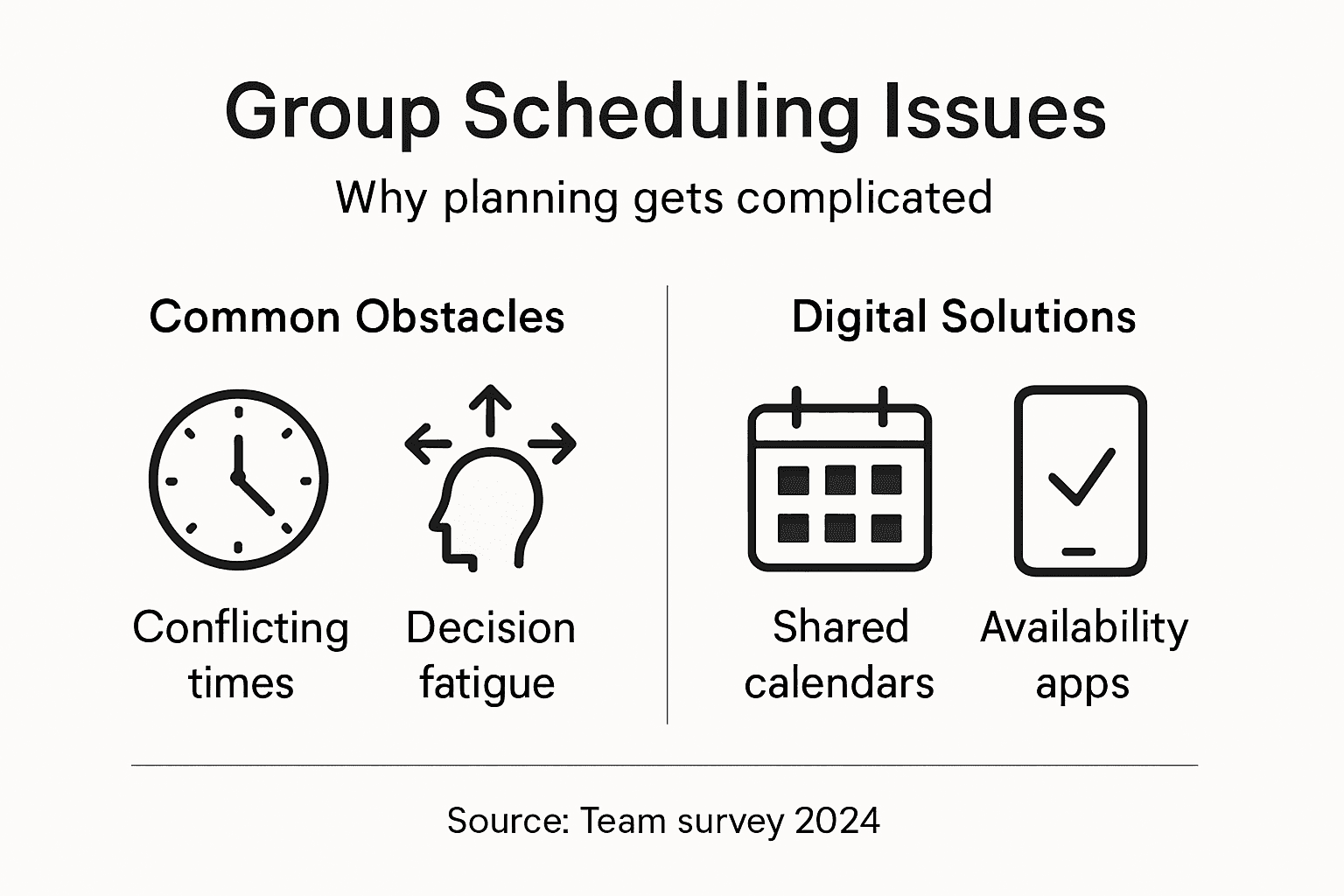
Group scheduling is far more complex than simply finding a mutually convenient time. At its core, it represents a delicate social puzzle involving multiple people's availability, preferences, and logistical constraints. Scheduling complexity in organizational settings reveals that coordinating activities involves navigating intricate human and resource dynamics.
The fundamental challenges of group scheduling emerge from several interconnected factors:
- Personal Time Variability: Each participant has unique schedules, commitments, and energy levels
- Communication Overhead: Coordinating preferences requires extensive back-and-forth messaging
- Decision Fatigue: Group members experience mental exhaustion from repeated planning attempts
- Conflicting Priorities: Individual needs and preferences rarely align perfectly
Understanding these challenges requires recognizing that scheduling is not just a logistical exercise but a complex social negotiation. Traditional methods like group texts or email chains often fail because they lack structured mechanisms for efficiently comparing availability and preferences.
Group scheduling transforms a simple task into a multidimensional social challenge that tests communication, compromise, and collective decision-making skills.
Moreover, digital technologies have both simplified and complicated group scheduling. While tools exist to help coordinate, they can sometimes introduce additional complexity by offering too many options or requiring extensive input from participants.
Pro tip: Establish clear communication protocols and use streamlined scheduling tools that minimize decision-making friction.
Here's a comparison of traditional versus modern group scheduling methods:
| Aspect | Traditional Methods | Modern Digital Tools |
|---|---|---|
| Coordination Speed | Slow, often days | Instant or near-instant |
| Communication Burden | High, repetitive messaging | Low, automated notifications |
| Visibility of Conflicts | Hard to detect overlaps | Real-time conflict tracking |
| User Effort Required | Manual input, error-prone | Automated suggestions, easy |
| Adaptability | Rigid, hard to reschedule | Dynamic, flexible options |
Types of Scheduling Conflicts and Issues
Scheduling conflicts represent complex social and logistical challenges that disrupt group coordination. Scheduling conflict dynamics reveal multiple intricate ways that time management can break down, creating frustration and inefficiency across personal and professional contexts.
The primary types of scheduling conflicts include:
- Double Booking: Accidentally scheduling multiple events simultaneously
- Resource Contention: Competing for limited shared spaces or equipment
- Availability Mismatches: Participants having incompatible time windows
- Priority Conflicts: Divergent preferences about meeting importance
- Communication Gaps: Lack of clear scheduling communication channels
These conflicts emerge from fundamental human variability. Project scheduling complexity demonstrates that even structured environments struggle with coordinating multiple stakeholders' schedules, highlighting the inherent challenges of group planning.
Scheduling conflicts are rarely about time itself, but about the intricate social negotiations required to align diverse individual needs.
Digital technologies have both simplified and complicated scheduling processes. While tools offer unprecedented coordination capabilities, they can also introduce overwhelming complexity by presenting too many options and requiring extensive participant input.
Pro tip: Implement a clear priority system and use centralized scheduling platforms that provide real-time availability tracking.
How Group Scheduling Tools Streamline Planning
Group scheduling tools have revolutionized the way people coordinate complex social and professional interactions. Advanced scheduling optimization techniques demonstrate how artificial intelligence and automated systems can dramatically reduce the cognitive load associated with finding mutually convenient meeting times.
The key features that make these tools transformative include:
- Automated Availability Matching: Instantly compare multiple participants' schedules
- Real-Time Conflict Detection: Highlight potential scheduling overlaps before they become problems
- Preference Aggregation: Collect and prioritize group members' time preferences
- Dynamic Rescheduling: Automatically suggest alternative time slots
- Integration with Personal Calendars: Sync across multiple digital platforms
Adaptive group scheduling technologies leverage sophisticated algorithms to transform the traditionally frustrating process of coordinating meetings. These tools use machine learning to understand individual preferences, creating personalized scheduling experiences that reduce negotiation time and minimize communication friction.
Modern scheduling tools are not just about finding a time, but about understanding the complex social dynamics of group coordination.
The evolution of these tools represents a significant leap forward in how we manage collective time. By removing manual coordination barriers, they enable more spontaneous, efficient, and stress-free planning across personal and professional contexts.

Pro tip: Choose scheduling tools that offer seamless integration with your existing calendar platforms and prioritize user-friendly interface design.
Impact of Social Group Dynamics on Coordination
Group coordination is a complex social phenomenon that extends far beyond simple logistical arrangements. Social group interaction patterns reveal intricate dynamics that fundamentally shape how people negotiate, communicate, and make collective decisions.
The key factors influencing group coordination include:
- Power Structures: Hierarchical relationships and individual influence levels
- Communication Patterns: Frequency, directness, and quality of interactions
- Cultural Backgrounds: Diverse perspectives and communication styles
- Individual Personality Types: Introversion, extroversion, and decision-making approaches
- Emotional Intelligence: Group members' ability to understand and manage interpersonal dynamics
Team effectiveness dynamics demonstrate that successful coordination depends on more than just scheduling. It requires understanding the subtle social mechanisms that enable or hinder collective action, including trust, mutual respect, and shared goals.
Effective group coordination is an art of balancing individual needs with collective objectives, requiring nuanced social intelligence.
Technology can support these dynamics, but cannot fully replace the human elements of negotiation, empathy, and mutual understanding that drive successful group interactions.
Pro tip: Invest time in understanding your group's unique social dynamics before attempting to coordinate complex plans.
The table below summarizes how different social dynamics affect group scheduling outcomes:
| Social Factor | Positive Scheduling Impact | Negative Scheduling Impact |
|---|---|---|
| Power Structures | Clear decision-making hierarchy | Unequal participation, friction |
| Communication Patterns | Quick consensus, clarity | Misunderstandings, delays |
| Cultural Backgrounds | Diverse ideas, creative solutions | Conflicting norms, misalignment |
| Personality Types | Balanced input, increased empathy | Dominance, lack of engagement |
| Emotional Intelligence | Smooth conflict resolution | Escalation of minor issues |
Common Mistakes and How to Avoid Them
Group scheduling is fraught with potential pitfalls that can derail even the most well-intentioned planning efforts. Frequent project scheduling errors demonstrate the critical importance of understanding and proactively addressing common coordination challenges.
The most prevalent mistakes in group scheduling include:
- Vague Time Commitments: Using phrases like "maybe" or "sometime"
- Overestimating Individual Capacity: Assuming everyone has unlimited availability
- Ignoring Personal Preferences: Failing to consider individual scheduling constraints
- Lack of Clear Communication: Not establishing explicit planning expectations
- Avoiding Conflict Resolution: Letting minor disagreements derail the entire planning process
Effective scheduling requires a strategic approach that anticipates and mitigates potential roadblocks. This means building flexibility into plans, establishing clear communication channels, and creating a collaborative environment that respects individual needs and group objectives.
The most successful group plans are those that balance structure with adaptability, recognizing that scheduling is both an art and a science.
Technology can help, but cannot completely replace thoughtful human coordination. The most effective scheduling strategies combine digital tools with empathetic, clear communication.
Pro tip: Always include a 15-20% buffer time in group scheduling to accommodate unexpected changes and individual variabilities.
Simplify Your Group Scheduling with Groop
Group scheduling challenges often arise from conflicting priorities and exhausting back-and-forth communication. The struggle to find clear availability and respect everyone's preferences can drain the energy out of planning. Groop understands these core pain points by focusing on reducing communication overload and smoothing out decision fatigue. By providing automated availability matching and surfacing scheduling conflicts in real time, Groop helps your group move past traditional planning headaches.
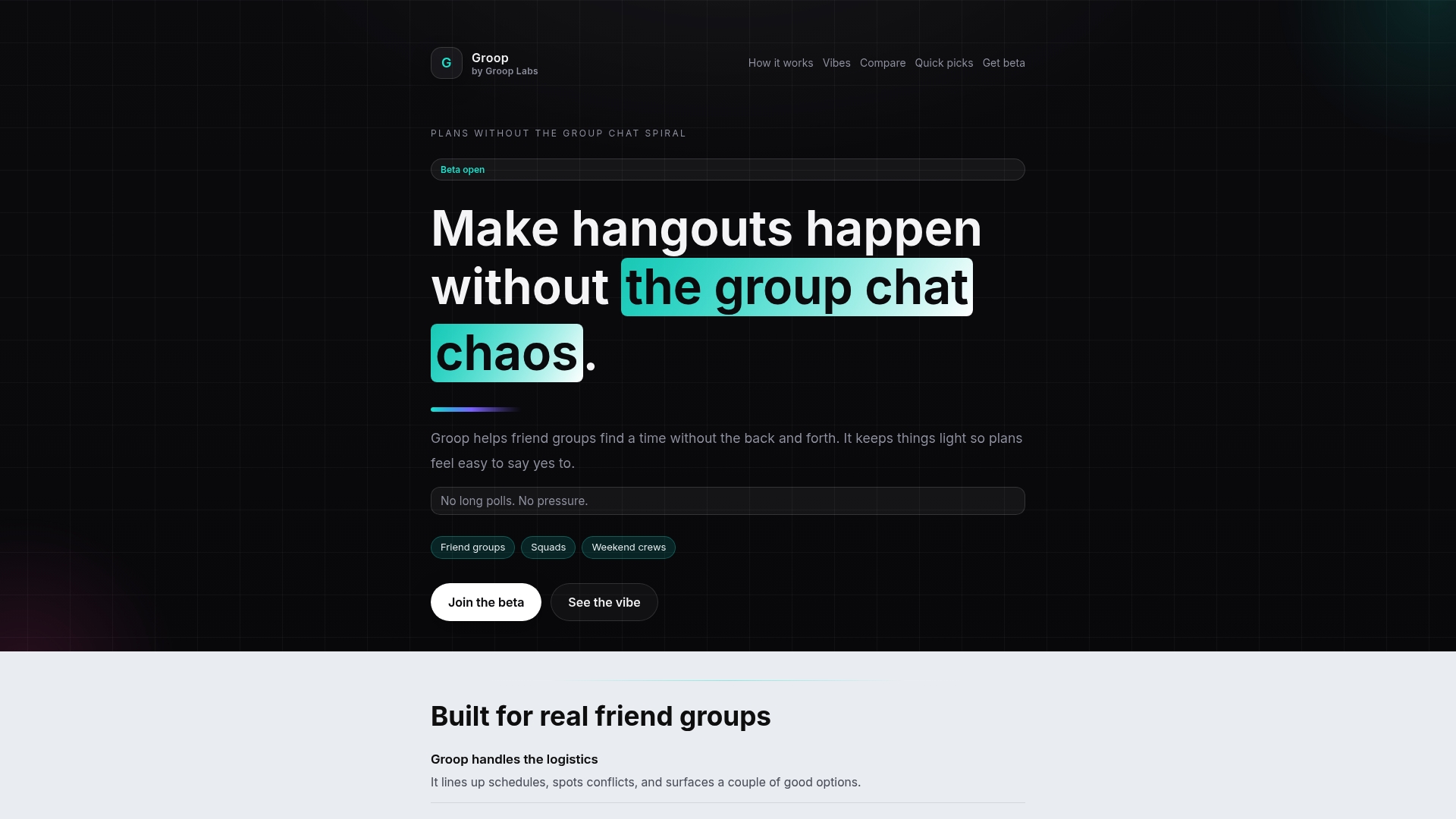
Ready to cut through the chaos and bring effortless group coordination to your social life? Experience how Groop’s lightweight and intuitive interface turns complex scheduling into a simple, stress-free process tailored for friend groups and small social squads. Visit Groop’s landing page now to start planning your next hangout with ease. Explore the group scheduling features and discover how you can keep your group’s vibe intact while effortlessly finding the best time for everyone.
Frequently Asked Questions
What are the main challenges of group scheduling?
The primary challenges include personal time variability, communication overhead, decision fatigue, and conflicting priorities among participants, making coordination a complex social negotiation.
How do group scheduling tools simplify the planning process?
Group scheduling tools simplify planning by automating availability matching, enabling real-time conflict detection, aggregating preferences, suggesting dynamic rescheduling options, and integrating with personal calendars.
What common mistakes should be avoided in group scheduling?
Common mistakes include vague time commitments, overestimating individual capacity, ignoring personal preferences, lack of clear communication, and avoiding conflict resolution. Recognizing and addressing these can lead to more effective scheduling.
How can social dynamics impact group scheduling outcomes?
Social dynamics can greatly influence group scheduling outcomes. Positive factors like good communication and emotional intelligence can facilitate consensus, while negative factors such as power imbalances and misunderstandings can lead to delays and conflicts.