
Articles
Why groups struggle to plan: beating social loafing
Discover why friend groups struggle to make plans and how social loafing, group size, and decision fatigue are the real culprits, plus practical fixes that work.
Why groups struggle to plan: beating social loafing
TL;DR:
- Social loafing causes decreased effort and follow-through in group plans due to shared responsibility.
- Smaller groups of three to five people improve decision-making and accountability.
- Clear roles, limited options, and scheduling tools help overcome planning paralysis and improve follow-through.
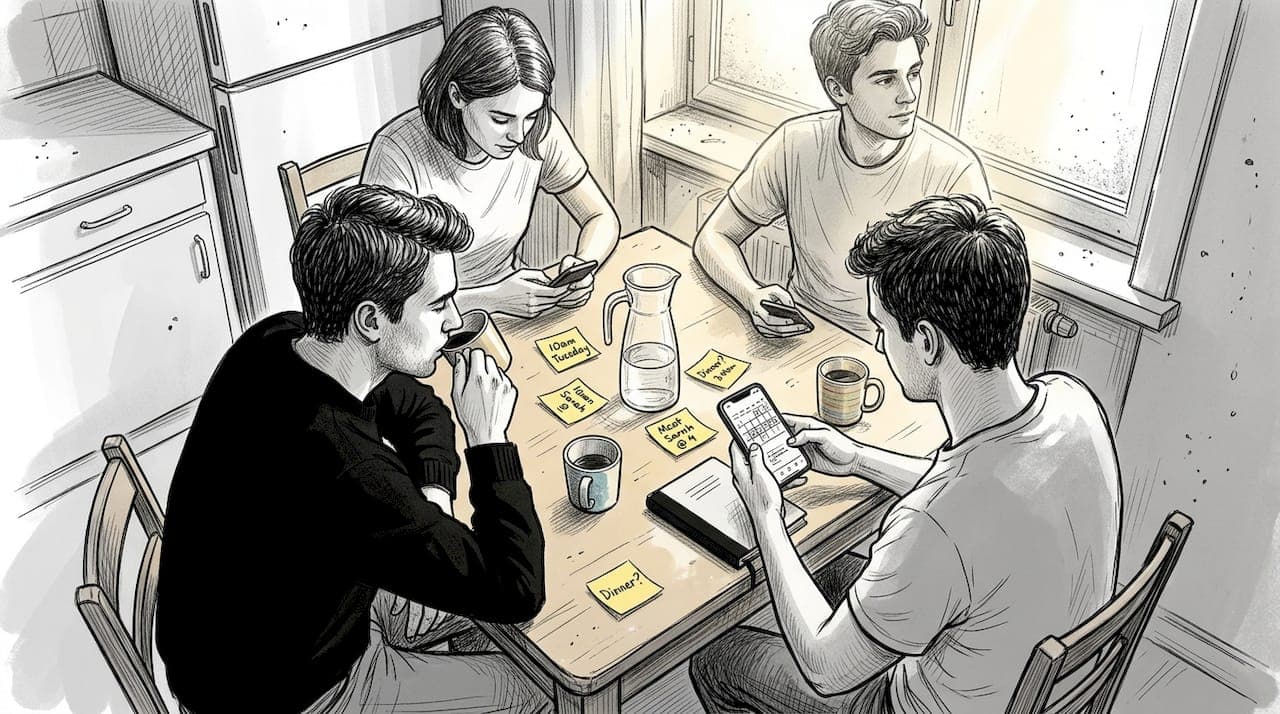
You've been there. The group chat blows up with excitement, everyone's hyped about Saturday plans, and then... nothing. Three days later, someone asks "so are we still doing this?" and the thread goes quiet again. It's not that your friends don't care. There's actually a well-documented psychological reason why even the most enthusiastic friend groups fail to follow through on plans. Understanding what's really going on behind the scenes can help you break the cycle and finally make those hangouts happen.
Table of Contents
- The psychology behind group struggles: Social loafing explained
- How group size and responsibility shape planning success
- Decision fatigue and choice overload: When options paralyze plans
- Groupthink vs. group loafing: What really blocks action?
- Making group plans work: Practical frameworks and tech tools
- Our take: Why owning responsibility, not 'the vibe,' changes everything
- Ready to make group planning easy?
- Frequently asked questions
Key Takeaways
| Point | Details |
|---|---|
| Social loafing dominates | Friend groups struggle mainly because shared responsibility makes people participate less in planning. |
| Keep groups small | Smaller group sizes help keep everyone accountable and plans on track. |
| Limit choices and assign roles | Giving people clear jobs and fewer options makes it much easier to finalize group plans. |
| Use digital tools wisely | Polls, deadlines, and planning apps streamline decisions and cut down on endless chat confusion. |
The psychology behind group struggles: Social loafing explained
Now that we've set the scene of group planning chaos, let's look at why this problem is so common.
Social loafing is the tendency for people to put in less effort when they're part of a group compared to when they're working alone. The logic is simple: when responsibility is shared across multiple people, each individual feels less personally accountable for the outcome. Groups struggle because diffused responsibility makes it easy for everyone to assume someone else will handle it.
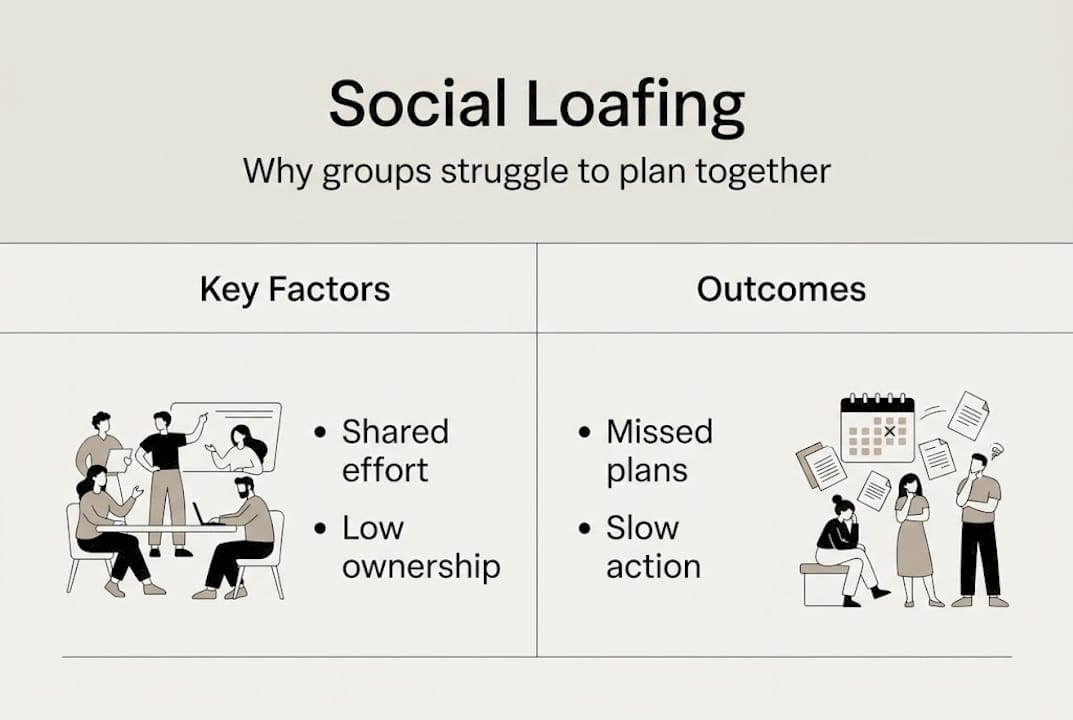
This isn't a new idea. French agricultural engineer Maximilien Ringelmann noticed it back in the 1880s when studying how hard men pulled on a rope. The Ringelmann effect shows that individual effort drops sharply as group size increases. In a tug-of-war with two people, each person pulls close to their maximum. Add eight people, and each person is contributing significantly less than their individual best.
Now apply that to your group chat. Someone floats a plan. Everyone reacts with enthusiasm. But when it comes to actually booking the place, picking the time, or confirming who's coming, the effort evaporates. Why? Because with eight people in the chat, each person assumes one of the other seven will take care of it.
"The more people involved in a task, the less any single person feels responsible for its success." This is the core of social loafing, and it plays out in group chats every single day.
Here's a quick comparison of how individual effort shifts depending on group context:
| Group size | Perceived personal responsibility | Likelihood of follow-through |
|---|---|---|
| 1 person | Very high | Very high |
| 2 to 3 people | High | High |
| 4 to 6 people | Moderate | Moderate |
| 7 or more | Low | Low |
The good news is that once you recognize this pattern, you can start using group planning strategies that directly counteract it. Awareness is the first step toward actually showing up on Saturday.
How group size and responsibility shape planning success
Understanding loafing leads naturally to the effects of group size and how clear roles can tip the balance.
Larger groups increase loafing because shared responsibility dilutes personal accountability. Smaller groups, on the other hand, naturally foster a sense of ownership because there are fewer people to hide behind. If there are only three of you, you can't quietly wait for someone else to step up.
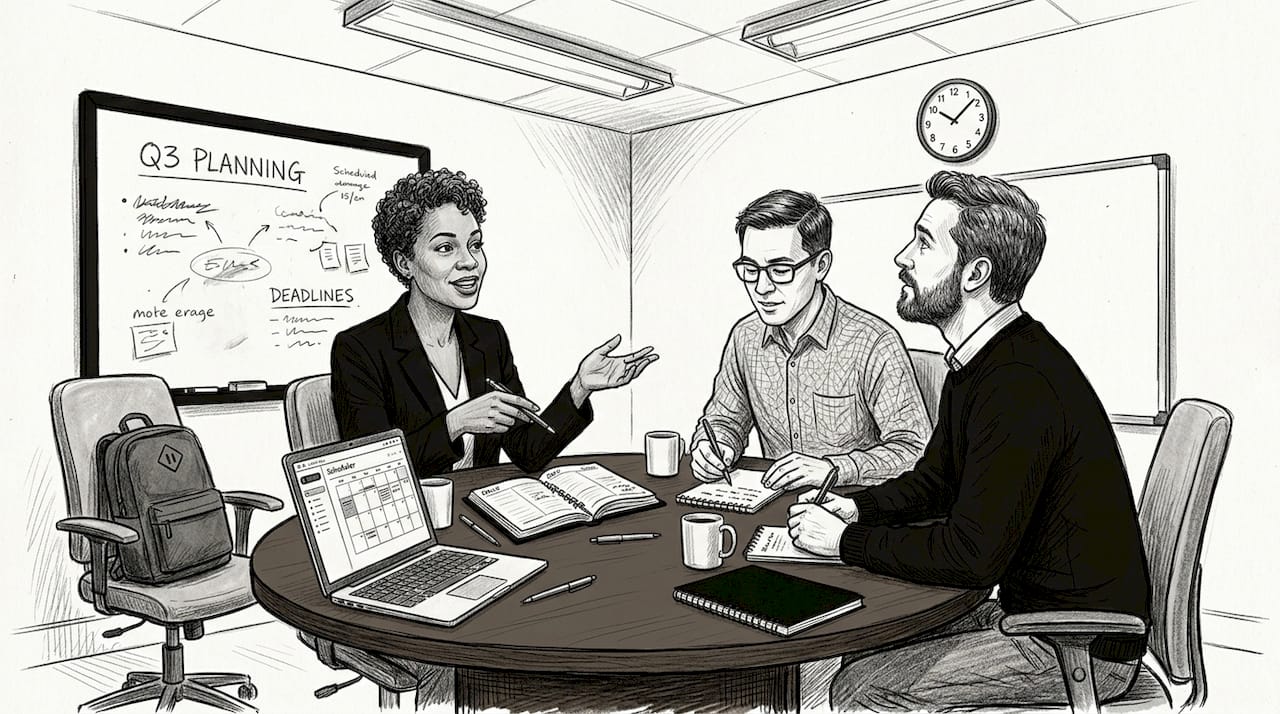
Research consistently points to groups of three to five people as the sweet spot for effective decision-making and follow-through. You get enough perspectives to make good choices, but not so many voices that the process stalls. The small group benefits are real: faster decisions, clearer communication, and less friction overall.
So what do you do when your friend group is bigger than five? You work around it. Here are some practical ways to bring accountability back:
- Assign a point person. One person owns the plan for this hangout. They send the final details, collect RSVPs, and make the call if something needs to change.
- Break into smaller sub-groups. For a big group outing, split logistics. One person handles the reservation, another handles the carpool, another confirms the time.
- Use explicit check-ins. Instead of a general "who's in?", ask each person directly. A direct question is much harder to ignore.
- Rotate the planner role. This prevents burnout and makes sure the same person isn't always carrying the load.
Pro Tip: Rotate who takes the lead on planning each hangout. When everyone knows their turn is coming, they pay closer attention to how the process works and are more likely to contribute when it's not their turn.
The group scheduling challenges that come with larger squads are real, but they're not insurmountable. Structure and role clarity can make even a ten-person group function smoothly.
Decision fatigue and choice overload: When options paralyze plans
Next, after group size, what else stops plans? Indecision and overload stall even the best groups.
Decision fatigue is what happens when the sheer number of choices drains your mental energy, making it harder to commit to any one option. In a group setting, this gets multiplied. Everyone has a preference, no one wants to be the one who picks wrong, and so the thread just keeps going in circles.
Choice overload is a closely related issue. When a group chat surfaces ten possible dates, five venue options, and three different activity ideas all at once, the result is analysis paralysis. Nobody decides because deciding feels overwhelming. Limiting options to three to five and setting clear deadlines are proven ways to cut through this fog.
Here's a step-by-step framework for simplifying scheduling and getting your group to an actual decision:
- Pre-select the options. One person narrows it down to two or three choices before presenting them to the group. This removes the burden of open-ended brainstorming.
- Set a response deadline. "Vote by Thursday night" is far more effective than "let me know whenever." A deadline creates urgency.
- Use a poll. Polls are faster than open discussion and give everyone an equal voice without the back-and-forth.
- Default to majority. Agree upfront that the majority vote wins. This prevents endless negotiation after the poll closes.
- Confirm with a single message. Once decided, send one clear summary: what, where, when. No more debate.
Pro Tip: When using group chats to plan, pin the final decision at the top of the conversation. It stops the "wait, what time was it again?" messages that derail momentum.
Decision fatigue is sneaky because it feels like indecision, but it's really just overload. Give your group fewer, better choices and watch how quickly things come together.
Groupthink vs. group loafing: What really blocks action?
We've covered decision fatigue, but what about other group dynamics like groupthink?
Groupthink is a different phenomenon. It happens when a group prioritizes harmony and consensus so strongly that they stop thinking critically. Members go along with the dominant opinion to avoid conflict, even if they privately disagree. It's most common in tightly bonded, high-stakes groups like corporate teams or committees.
For casual friend groups, groupthink is less applicable to everyday planning. Your squad isn't suppressing dissent to maintain cohesion when deciding where to eat. What looks like groupthink in a friend group is usually just everyone waiting for someone else to speak first, which is classic loafing.
That said, it's worth knowing the signs of each so you can tell them apart:
Signs of social loafing in your group chat:
- Messages go unanswered for hours or days
- Everyone agrees something sounds fun but nobody takes action
- Plans keep getting pushed without a clear reason
- Responses are vague ("yeah maybe," "I'll see")
Signs of groupthink (rarer in casual settings):
- One person's idea always wins without real discussion
- People privately complain but publicly agree
- The group avoids revisiting decisions even when things go wrong
It's also worth noting that empirical support for groupthink is less consistent than for social loafing, which has been robustly demonstrated across many studies. So if your group's plans keep falling apart, loafing and indecision are almost certainly the culprits, not some deep consensus problem.
Understanding the real cause matters because the fix is different. Loafing needs accountability. Groupthink needs psychological safety. Most friend groups need the former, and recognizing that makes the path forward much clearer. Check out more on social planning challenges to see how these dynamics play out in real scenarios.
Making group plans work: Practical frameworks and tech tools
With the causes and pitfalls clear, let's map out how to succeed as a group, step by step.
The most effective approach combines clear structure with the right tools. Structure handles the human side (accountability, roles, deadlines). Tools handle the logistics (scheduling, communication, confirmation). Together, they remove most of the friction that kills plans before they start.
Here's a practical framework you can use right now:
- Assign a plan owner. Every hangout needs one person who is responsible for seeing it through. Assigning roles and setting deadlines dramatically increases follow-through.
- Limit the choices. Present two or three options, not ten. Pre-filtered choices are easier to act on.
- Set a hard deadline. "Decide by Wednesday" keeps things moving. Open-ended timelines invite procrastination.
- Use a scheduling or polling tool. Apps that surface everyone's availability in one place eliminate the endless back-and-forth of "when are you free?"
- Send a confirmation message. Once the plan is set, send a single, clear summary to the whole group. Clarity prevents last-minute drop-offs.
For step-by-step social planning, the key is reducing the number of decisions the group has to make in real time. The more you can pre-decide, the smoother the whole process feels.
When it comes to group chat app recommendations, look for tools that combine scheduling, polling, and confirmation in one place. Switching between five different apps adds friction and gives people more opportunities to disengage.
The goal isn't a perfect system. It's a simple, repeatable one that your group can actually stick to.
Our take: Why owning responsibility, not 'the vibe,' changes everything
Let's step back and share a frank viewpoint on why most advice misses the real fix for group planning.
Most articles tell you to find a better app or communicate more openly. That's fine advice, but it skips the uncomfortable truth: most friend groups fail to make plans because nobody wants to be the person who takes charge. There's a fear of being seen as bossy, or of making the wrong call and getting blamed for a bad time.
So everyone defaults to "wait and see," and the plan dies quietly.
The real shift isn't technological. It's cultural. When one person in the group decides to own the logistics, not because it's their personality but because they've agreed to take the role this time, everything changes. Plans get made. People show up. The vibe takes care of itself.
We've seen this play out consistently. Every friend group that plans well has at least one person who's willing to send the follow-up message, make the reservation, and say "we're doing this Saturday at 7." It's a habit, not a personality type. And it can be rotated.
Explore more on young adult planning trends to see how your generation is rethinking coordination. The groups that figure this out stop waiting for the perfect moment and start creating it.
Ready to make group planning easy?
With these strategies in mind, you're one step from making group plans happen effortlessly.
Grooop by Groop Labs is built exactly for this. It takes the friction out of coordination by automatically surfacing everyone's availability, flagging conflicts, and offering simple, pre-filtered choices so your group can decide fast and move on to actually having fun. No more endless threads. No more "wait, what time was it?"
If you're ready to stop letting plans fall through the cracks, the Groop Labs group planner gives your squad the structure it needs without killing the spontaneity. You can also explore a simple event workflow to see how easy it can be to go from idea to confirmed hangout in minutes.
Frequently asked questions
What is social loafing and how does it affect group planning?
Social loafing is when people put in less effort in a group because responsibility is shared, making it easy for everyone to assume someone else will handle the planning. This is why group chats often end in enthusiasm but no action.
How can we stop our group chats from going in circles?
Assign one person to organize, use polls to limit choices to three to five, and set a clear deadline for responses. These three steps alone cut most of the confusion.
Does group size really make planning harder?
Yes. Larger groups increase loafing because accountability gets diluted across more people, while smaller groups of three to five act faster and follow through more reliably.
Is groupthink a real problem for friend groups?
Groupthink is less applicable to casual friend planning. Most squads face indecision and loafing, not a situation where everyone is silently going along with a bad idea to avoid conflict.