
Articles
Small Group Planning Benefits for Social Life
Small group planning benefits include stronger connections, less scheduling chaos, and more relaxed gatherings. Learn how to optimize your social plans.

Small Group Planning Benefits for Social Life

No one wants to be stuck in endless group chats just to plan a simple night out in Toronto, London, or Sydney. For young adults balancing friendships and busy city life, chaotic messaging threads drain the fun from last-minute meetups. By shifting to small group planning, you can turn your crew's social calendar into a smooth, intentional experience where everyone's voice matters and hanging out feels effortless.
Table of Contents
- Defining Small Group Planning For Social Gatherings
- Key Features That Enhance Coordination
- How Small Groups Improve Social Experiences
- Typical Challenges And Smart Workarounds
- Comparing Small Versus Large Group Planning
Key Takeaways
| Point | Details |
|---|---|
| Intentional planning enhances social connections | Small group planning focuses on creating meaningful gatherings that foster deeper relationships among participants. |
| Technology streamlines coordination | Utilizing digital platforms for real-time communication boosts planning efficiency and increases engagement among group members. |
| Defined roles promote accountability | Distributing responsibilities within the group encourages participation and helps manage dynamics effectively. |
| Flexibility mitigates common challenges | Adapting communication strategies and scheduling practices can alleviate issues like unequal participation or decision fatigue in small groups. |
Defining Small Group Planning for Social Gatherings
Small group planning transforms social interactions from chaotic text exchanges into intentional, meaningful gatherings. At its core, small group planning represents a strategic approach to coordinating social activities among a close-knit collection of individuals, typically ranging from 3-8 people who share common interests, goals, or social connections.
Understanding small group dynamics reveals crucial insights into why planning matters. Sharing perceptions and motivations becomes the fundamental mechanism that distinguishes these intimate social units from larger, less personal gatherings. The structure of small groups involves several key characteristics:
- Intentional membership selection
- Clear communication channels
- Shared goals or social objectives
- Flexible yet consistent interaction patterns
- Mutual accountability among participants
Small group planning goes beyond mere scheduling—it's about creating meaningful social experiences. These gatherings are designed to foster deeper connections, allowing participants to share perspectives, support each other's interests, and build lasting relationships. Unlike large events where individual voices can get lost, small group planning ensures every participant has space for genuine interaction.
Social Coordination Strategies emerge as critical components in successful small group planning. These strategies involve understanding each member's availability, preferences, and comfort levels while maintaining a low-pressure environment that encourages participation.
Pro tip: Create a shared digital space where group members can contribute ideas, preferences, and potential scheduling options to democratize the planning process and increase collective engagement.
Key Features That Enhance Coordination
Successful small group coordination requires a strategic approach that goes beyond simple scheduling. Small group planning and problem-solving processes provide a structured framework for transforming social interactions from random exchanges to purposeful gatherings.
The key features that elevate group coordination involve several critical components:
- Clear Communication Channels: Establishing transparent and efficient ways for group members to share information
- Collaborative Goal Setting: Defining shared objectives that motivate collective participation
- Flexible Scheduling Mechanisms: Creating adaptable planning strategies that accommodate individual preferences
- Role Distribution: Assigning specific responsibilities to enhance group accountability
- Continuous Feedback Loops: Implementing mechanisms for ongoing group evaluation and adjustment
Technology plays a pivotal role in modern group coordination. Digital platforms now enable real-time collaboration, allowing members to synchronize schedules, share preferences, and make collective decisions with unprecedented ease. These tools transform the traditional back-and-forth communication into a streamlined, interactive planning experience.
Technological Integration has become a game-changer in small group dynamics. By leveraging digital platforms, groups can now coordinate more efficiently, reducing friction and increasing the likelihood of successful gatherings. The ability to instantly communicate, vote on preferences, and adjust plans in real-time represents a significant evolution in social coordination.
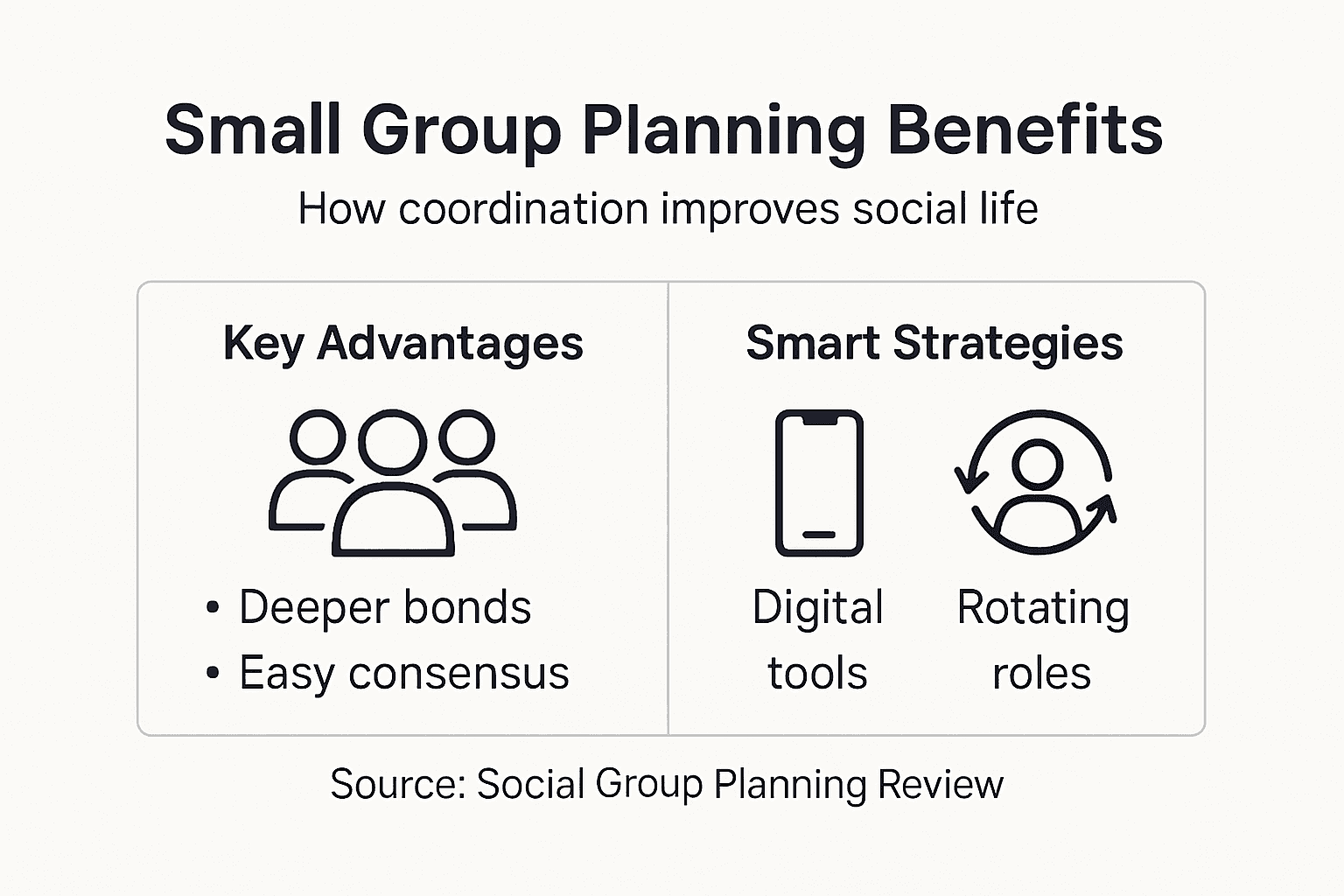
This table provides a concise comparison of digital tools that enhance small group coordination.
| Platform Type | Key Functionality | Impact on Social Planning |
|---|---|---|
| Group Messaging Apps | Real-time chat, polls, scheduling | Increases responsiveness and collective input |
| Shared Calendars | Visual schedule alignment | Reduces scheduling conflicts and overlaps |
| Collaborative Documents | Idea collection and task tracking | Boosts transparency and accountability |
Pro tip: Designate a rotating "coordination champion" in your group who takes temporary responsibility for synthesizing everyone's input and moving plans forward.
How Small Groups Improve Social Experiences
Small groups represent powerful social ecosystems that transform individual interactions into meaningful, supportive experiences. Collaborative discussions enhance social acceptance by creating environments where individuals can develop deeper, more authentic connections.
The profound social benefits of small groups manifest through several key dimensions:
- Emotional Support: Providing a safe space for vulnerability and genuine sharing
- Mutual Accountability: Encouraging personal growth through collective engagement
- Diverse Perspective Exchange: Broadening individual worldviews through varied interactions
- Skill Development: Practicing communication and interpersonal skills in low-stakes environments
- Reduced Social Isolation: Creating consistent opportunities for meaningful connection
Modern small groups leverage technology to amplify social experiences, transforming traditional interaction models. Digital platforms now enable more nuanced, flexible social connections that transcend physical limitations, allowing individuals to build and maintain relationships with unprecedented ease and creativity.

Social Dynamics have fundamentally shifted with the rise of intentional, technology-enabled small group interactions. By creating structured yet flexible social environments, these groups provide a powerful antidote to the fragmentation and superficiality often associated with contemporary social interactions.
Pro tip: Experiment with rotating leadership and discussion topics to keep your small group dynamic, engaging, and continuously evolving.
Typical Challenges and Smart Workarounds
Small group dynamics inevitably encounter obstacles that can derail social connections and collaborative efforts. Identifying barriers to group goals represents the first critical step in maintaining productive and engaging social interactions.
The most common challenges in small group planning include:
- Unequal Participation: When some members dominate conversations while others remain silent
- Scheduling Conflicts: Difficulty finding mutually convenient meeting times
- Communication Breakdowns: Misunderstandings or inconsistent information sharing
- Decision Fatigue: Struggling to reach consensus or make collective choices
- Motivation Imbalances: Varying levels of commitment among group members
Smart workarounds require a proactive and strategic approach to group management. Implementing flexible communication strategies, establishing clear expectations, and creating supportive group norms can transform potential obstacles into opportunities for deeper connection and mutual understanding.
Group Dynamics are complex ecosystems that require intentional navigation. By anticipating potential challenges and developing adaptive strategies, small groups can create resilient social structures that evolve and grow with their members' changing needs and preferences.
Pro tip: Develop a group agreement that outlines communication expectations, decision-making processes, and shared values to preemptively address potential conflicts.
Comparing Small Versus Large Group Planning
Group planning strategies dramatically differ between small and large social contexts, with each approach presenting unique advantages and challenges. Small group discussions yield significantly higher participation rates compared to broader, less intimate gathering formats.
Key comparative dimensions between small and large group planning include:
- Interaction Quality: Small groups enable deeper, more meaningful exchanges
- Scheduling Complexity: Smaller groups offer more flexible coordination
- Individual Voice: Enhanced opportunities for personal contribution in small groups
- Decision-Making Speed: Faster consensus in smaller, more agile groups
- Interpersonal Dynamics: More nuanced relationship building in intimate settings
Large group planning often struggles with challenges that small groups naturally mitigate. The sheer volume of participants creates logistical barriers, reduces individual engagement, and makes coordinated decision-making exponentially more difficult. In contrast, small groups can pivot quickly, adapt to changing preferences, and maintain a sense of collective ownership over plans and outcomes.
Here’s a quick reference of group size effects on planning efficiency.
| Group Size | Planning Complexity | Engagement Level | Consensus Speed |
|---|---|---|---|
| Small (3-8) | Low, flexible coordination | High personal involvement | Rapid agreement |
| Large (20+) | High, formal processes needed | Lower individual visibility | Slower, requires formal vote |
Social Coordination requires different strategies at different scales. While large groups might rely on formal structures and hierarchical communication, small groups can leverage more organic, fluid approaches that prioritize personal connections and shared experiences.
Pro tip: Implement a rotating facilitation model in small groups to ensure equitable participation and prevent leadership stagnation.
Simplify Your Small Group Planning with Grooop
The article highlights common challenges in coordinating small social gatherings such as scheduling conflicts, communication breakdowns, and decision fatigue. These pain points often make it hard to organize meaningful and low-pressure get-togethers with your close-knit group. Concepts like flexible scheduling mechanisms and clear communication channels are essential for transforming typical back-and-forth chaos into smooth social coordination.
Grooop is designed exactly for this purpose. Our mobile app offers a lightweight scheduling tool that lines up everyone’s availability automatically and surfaces conflicts clearly. This lets your group quickly choose meeting times without long polls or overwhelming chats. It keeps your group’s vibe intact by focusing on easy, natural options that respect personal preferences. Whether you are planning a casual hangout, study session, or outdoor outing, Grooop helps your small social circle stay connected with less hassle.
Experience firsthand how intentional, efficient planning can deepen your social experiences.
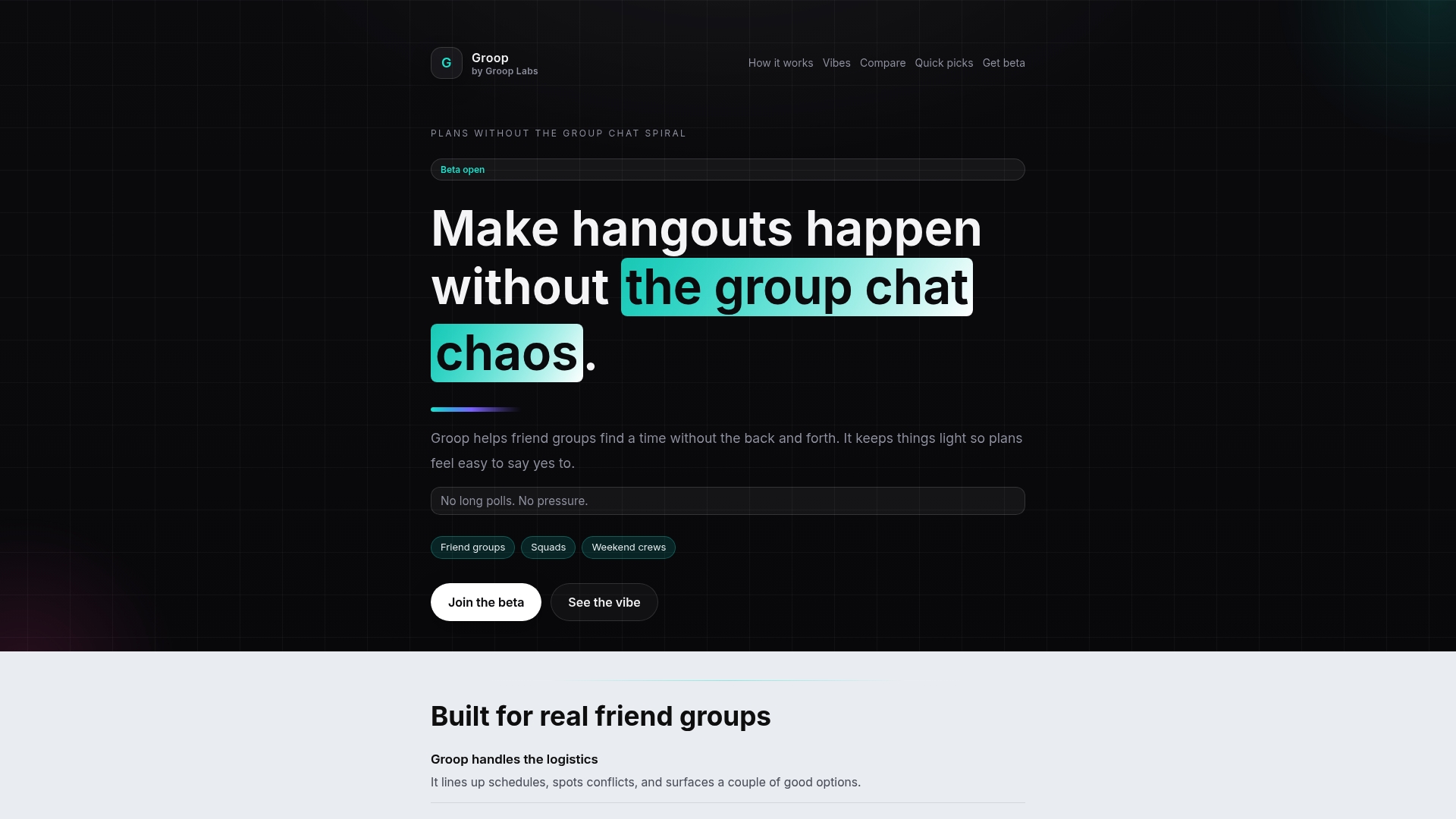
Ready to leave scheduling headaches behind and enjoy more meaningful moments? Start simplifying your small group plans with Grooop today. Visit the landing page to see how our streamlined tool can transform your group’s coordination. Don’t wait let Grooop take the stress out of planning so you can focus on what matters most—spending time with your friends.
Frequently Asked Questions
What are the main benefits of small group planning for social gatherings?
Small group planning fosters deeper connections, enhances communication, promotes mutual accountability, and allows for more equal participation among members, resulting in more meaningful social experiences.
How can technology improve small group planning?
Technology enhances small group planning by providing digital platforms that facilitate real-time collaboration, scheduling, and communication, making it easier for members to coordinate and share preferences seamlessly.
What strategies can I use to encourage participation in small group gatherings?
Utilize clear communication channels, establish shared goals, assign roles, and create a low-pressure environment that values each member's input to boost participation and engagement during gatherings.
What are common challenges in small group planning, and how can I overcome them?
Common challenges include unequal participation, scheduling conflicts, and decision fatigue. To overcome these, establish clear expectations, implement flexible communication strategies, and create a group agreement to proactively address potential conflicts.