
Articles
Group Chats: Simplifying Social Planning Together
Learn how group chats streamline event planning by surfacing availability, reducing chaos, and empowering relaxed, efficient decision-making for friend groups.

Group Chats: Simplifying Social Planning Together

Every friend group knows the struggle of trying to plan a simple get-together, only to end up buried in endless messages and missed details. Group chats act as dynamic communication environments that help friends coordinate plans, swap updates, and build lasting connections across geographic boundaries. For young adults juggling busy schedules and global friendships, discovering the right tools for efficient social planning means less chaos and more time for actual hangouts.
Table of Contents
- Defining Group Chats For Social Planning
- Types Of Group Chats And Coordination Tools
- Key Features Driving Efficient Scheduling
- How Group Chats Reduce Planning Chaos
- Common Challenges And Mistakes To Avoid
Key Takeaways
| Point | Details |
|---|---|
| Group Chats Enhance Coordination | Digital group chats streamline social planning, enabling real-time messaging and collaborative decision-making across distances. |
| Variety of Chat Types | Different group chat types cater to specific coordination needs, from professional settings to casual social gatherings. |
| Key Features Improve Scheduling | Advanced scheduling features like availability matching and instant voting reduce planning chaos and enhance efficiency. |
| Common Challenges to Navigate | Effective group communication requires awareness of information overload and promoting equal participation for productive interactions. |
Defining Group Chats for Social Planning
Group chats represent digital spaces where friends, colleagues, and communities coordinate activities, share information, and maintain social connections. Unlike traditional communication methods, these dynamic platforms transform how people plan and interact. Digital communication networks have fundamentally reshaped social coordination strategies.
At their core, group chats are collaborative digital environments that enable multiple participants to communicate simultaneously. These platforms serve several key functions:
- Instant messaging and real-time coordination
- Sharing event details and scheduling
- Collaborative decision-making
- Maintaining social connections across geographic boundaries
- Reducing communication friction between group members
Research indicates that group chats go beyond simple messaging. Collaborative communication environments foster interactive dynamics that help groups maintain social presence and facilitate collective planning. These digital spaces act as modern communication hubs, replacing traditional in-person coordination methods.
Modern group chats integrate multiple features that make social planning seamless. They transform how young adults organize hangouts, coordinate study sessions, and maintain friendships across different locations. The technology enables fluid, pressure-free communication that adapts to contemporary social interaction needs.
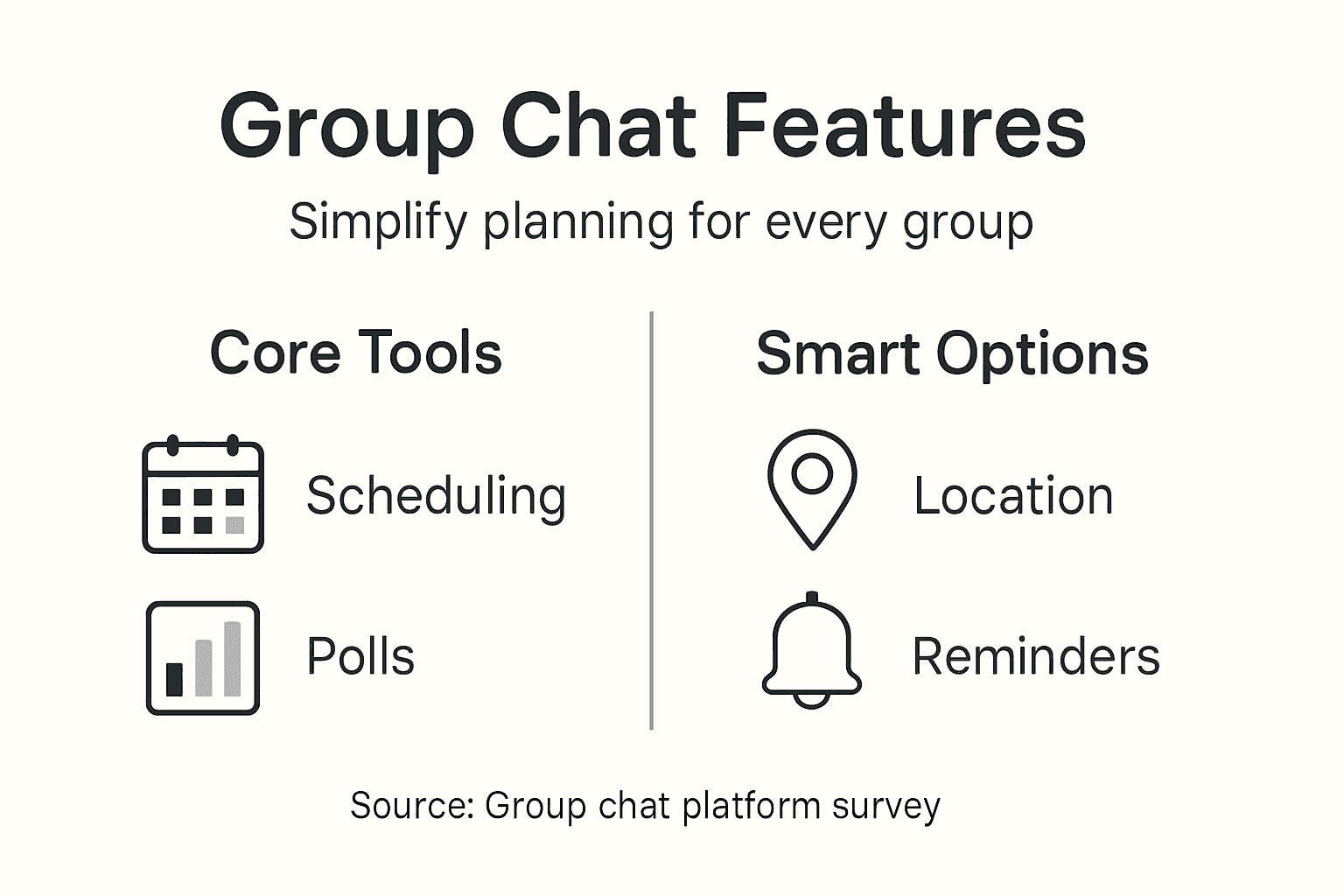
Pro tip: Choose group chat platforms that prioritize user experience and offer clear, intuitive scheduling features to minimize planning complexity.
Types of Group Chats and Coordination Tools
Group chats have evolved into sophisticated digital platforms with diverse coordination capabilities. Social media collaboration tools now offer specialized features that transform how groups interact, plan, and make decisions collectively.
Researchers have identified several key types of group chat coordination tools:
- Professional Collaboration Chats: Work-focused platforms enabling team communication
- Social Planning Chats: Casual groups coordinating personal events and hangouts
- Academic Study Groups: Focused environments for student collaboration
- Hobby and Interest Communities: Specialized networks connecting enthusiasts
- Family Communication Channels: Private spaces for intimate group interactions
Group interaction dynamics reveal that different chat types support unique coordination needs. Some platforms prioritize real-time messaging, while others emphasize scheduling and structured decision-making. These tools adapt to various group sizes and interaction patterns, from small friend circles to large organizational teams.
Modern group chat platforms integrate multiple features like shared calendars, voting mechanisms, and instant location sharing. These technological innovations help young adults navigate complex social planning challenges, reducing communication friction and making collective decision-making more intuitive and engaging.

Here's a comparison of popular group chat types and the unique coordination benefits they offer:
| Group Chat Type | Main Purpose | Ideal Group Size | Unique Benefit |
|---|---|---|---|
| Professional Collaboration | Team projects | 5-50 people | Streamlines work processes |
| Social Planning | Organizing hangouts | 3-15 people | Simplifies casual meetups |
| Academic Study Group | Study sessions | 2-12 students | Enhances collaborative learning |
| Hobby & Interest Community | Shared passions | 10-100+ members | Fosters skill-based connections |
| Family Communication | Family updates | 3-12 relatives | Maintains close relationships |
Pro tip: Select group chat tools that match your specific coordination needs and offer flexible communication options.
Key Features Driving Efficient Scheduling
Efficient scheduling relies on sophisticated digital features that transform group communication dynamics. Group chat interaction patterns demonstrate how carefully designed technological tools can dramatically improve social coordination and decision-making processes.
Key features that drive efficient group scheduling include:
- Availability Matching: Automatically comparing participant schedules
- Real-Time Voting Mechanisms: Quick consensus-building tools
- Smart Notification Systems: Intelligent reminders and updates
- Contextual Messaging: Understanding conversation intent and priority
- Time Zone Synchronization: Seamless global group coordination
Dialogue interaction classification reveals the critical importance of context-aware communication features. These advanced tools go beyond simple messaging, incorporating nuanced understanding of participant interactions, turn-taking dynamics, and communication flow.
Modern scheduling platforms leverage artificial intelligence and machine learning to predict group preferences, reduce planning friction, and create more intuitive coordination experiences. By analyzing historical interaction patterns, these tools can suggest optimal meeting times, understand individual scheduling constraints, and facilitate smoother group decision-making processes.
Pro tip: Prioritize group chat tools with adaptive learning capabilities that understand your specific social coordination patterns.
How Group Chats Reduce Planning Chaos
Group communication has transformed dramatically with digital tools that streamline social planning. Social coordination technologies create inclusive environments that dramatically reduce the traditional friction associated with organizing group activities.
Key strategies for minimizing planning chaos include:
- Centralized Information Hub: Single location for all event details
- Instant Decision Tracking: Real-time consensus monitoring
- Transparent Communication: Clear visibility into group preferences
- Conflict Resolution Tools: Automated suggestion and compromise mechanisms
- Asynchronous Participation: Allow members to contribute at different times
Communication rhythm dynamics demonstrate that effective group chats create structured yet flexible interaction spaces. These platforms eliminate the endless back-and-forth texting, multiple email chains, and confusing scheduling attempts that typically derail group planning efforts.
Modern group chat technologies leverage intelligent algorithms to understand participant preferences, predict potential scheduling conflicts, and suggest optimal meeting times. By reducing cognitive load and providing transparent, user-friendly interfaces, these tools transform chaotic planning processes into smooth, enjoyable social coordination experiences.
Consider these common scheduling problems and how modern group chat features help solve them:
| Planning Challenge | Traditional Impact | Modern Feature Solution |
|---|---|---|
| Conflicting Schedules | Repeated rescheduling | Automated availability matching |
| Missed Information | Lost emails or texts | Centralized chat history |
| Decision Delays | Endless back-and-forth | Real-time voting and polls |
| Exclusion of Members | Unseen messages | Smart notifications and reminders |
| Time Zone Confusion | Errors in meeting times | Automatic time zone adjustment |
Pro tip: Establish clear communication guidelines and use group chat features that promote quick, inclusive decision-making.
Common Challenges and Mistakes to Avoid
Group communication dynamics reveal numerous potential pitfalls that can derail effective social planning. Group interaction challenges highlight the complex social landscape that emerges within digital communication spaces.
Critical mistakes that undermine group chat effectiveness include:
- Information Overload: Flooding the chat with excessive messages
- Lack of Clear Purpose: Undefined goals and unclear planning objectives
- Unequal Participation: Dominating conversations or excluding quieter members
- Inconsistent Communication Rhythm: Sporadic and unpredictable messaging patterns
- Emotional Misinterpretation: Misunderstanding tone and intent in text-based communication
User interaction design demonstrates that negative communication patterns can significantly reduce group engagement and productivity. Successful group chats require intentional strategies that promote inclusive, respectful, and goal-oriented interactions.
Navigating group chat challenges requires emotional intelligence, clear communication guidelines, and a commitment to creating a supportive digital environment. Participants must balance individual preferences with collective goals, using technology as a tool for connection rather than a source of additional stress.
Pro tip: Establish group chat ground rules early and periodically review communication dynamics to maintain a positive, productive interaction space.
Simplify Your Social Planning With Grooop
Social planning chaos can be overwhelming with endless messages, conflicting schedules, and decision delays as the article highlights. When coordinating hangouts or study sessions, you want clear, pressure-free communication that respects everyone’s availability and vibe. Grooop understands these challenges and offers a lightweight scheduling tool built to cut through the noise by automatically matching availability, surfacing conflicts, and letting your group choose from simple, manageable options.
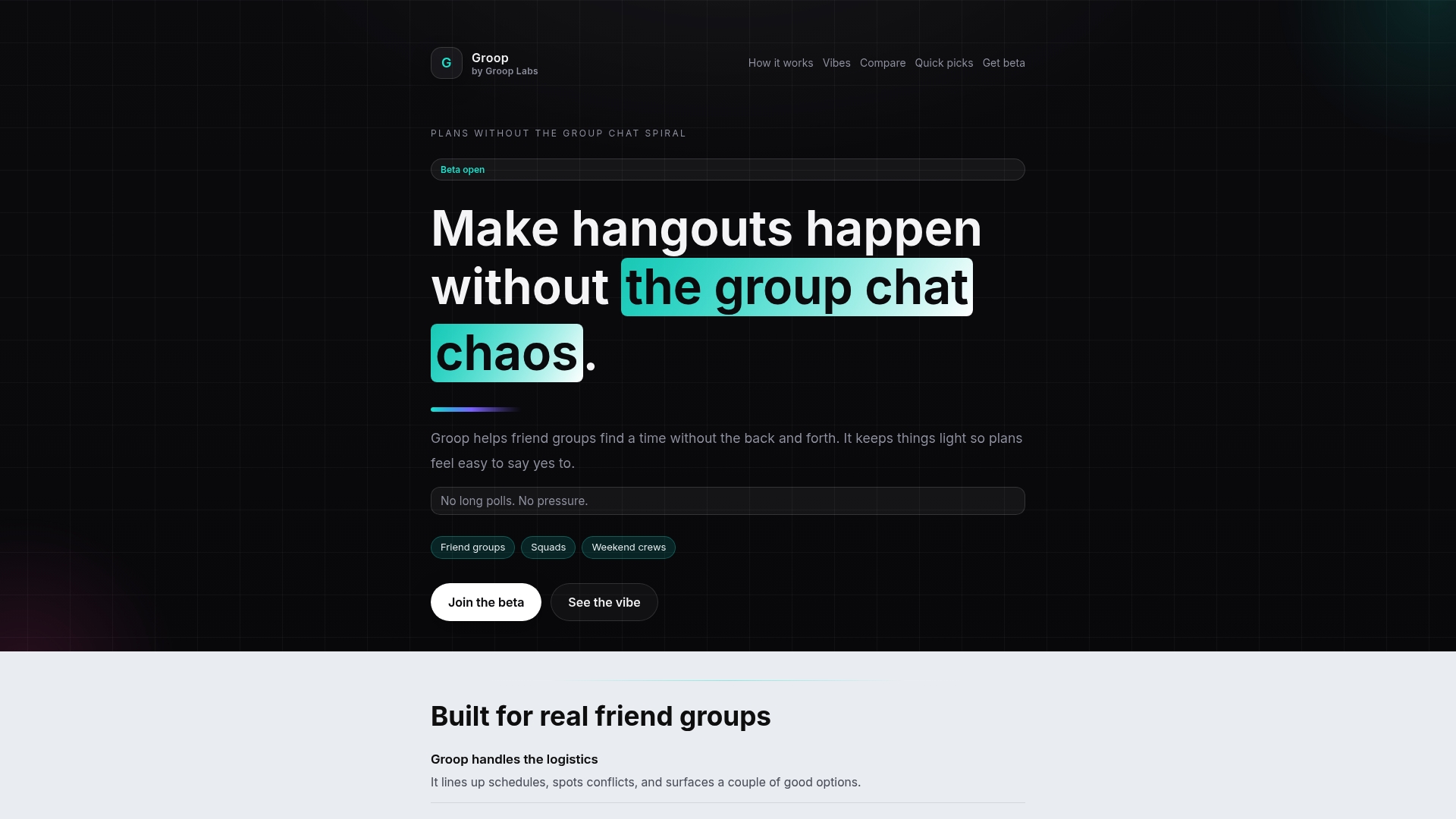
Experience how Grooop transforms group chats into smooth, intuitive planning hubs. Stop wasting time on complicated polling or confusing conversations. Visit Grooop Labs now and discover how this app makes planning effortless for friend groups, siblings, and social squads who want hassle-free coordination. Bring peace to your group communication and turn social planning into something everyone looks forward to. Get started today at Grooop Labs.
Frequently Asked Questions
What are group chats used for in social planning?
Group chats are used for coordinating activities, sharing event details, scheduling, collaborative decision-making, and maintaining social connections among friends, colleagues, and communities.
How can I choose the right group chat platform?
Select a group chat platform that prioritizes user experience, offers clear scheduling features, and matches your specific coordination needs, whether for professional collaboration, social planning, or academic purposes.
What features enhance the efficiency of scheduling in group chats?
Key features include availability matching, real-time voting mechanisms, smart notification systems, contextual messaging, and time zone synchronization, all of which improve communication dynamics and reduce planning friction.
What common mistakes should be avoided in group chats?
Common mistakes include information overload, lack of clear purpose, unequal participation, inconsistent communication rhythm, and emotional misinterpretation. Establishing ground rules can help maintain positive interactions.