
Articles
Group Chat Dynamics Explained: Better Friend Planning
Group chat dynamics explained for friend groups—learn about types, communication patterns, coordination for plans, common pitfalls, and top fixes.

Group Chat Dynamics Explained: Better Friend Planning

Trying to pick a night for pizza in a group chat, but all you get are inside jokes and vague replies? If you and your friends rely on messaging apps to coordinate hangouts, you know the struggle. What happens in your chat is more than random chatter. Group chat dynamics—from chat rhythm to emotional tone—decide if your plans actually happen or get lost in a sea of memes. Unlocking these patterns helps make scheduling hangouts with your crew a breeze.
Table of Contents
- What Are Group Chat Dynamics?
- Types of Group Chats and Their Vibes
- How Communication Patterns Shape Decision-Making
- Coordination and Scheduling in Chats
- Common Pitfalls of Group Planning
- Keys to Healthier, More Effective Chats
Key Takeaways
| Point | Details |
|---|---|
| Understand Group Chat Dynamics | Recognizing the emotional tone and interaction patterns helps enhance participation and coordination within different group types. |
| Assign Planning Roles | Designate a planner for group activities to ensure clarity and accountability in scheduling. |
| Establish Clear Communication Norms | Setting expectations for response times and decision-making processes can reduce confusion and enhance planning efficiency. |
| Balance Social and Logistical Messages | Mixing personal interactions with explicit logistical communication fosters a supportive environment that encourages engagement and commitment. |
What Are Group Chat Dynamics?
Group chat dynamics refers to the complex web of interactions, behaviors, and emotional exchanges that happen when multiple people communicate together in a messaging space. It's not just about sending messages back and forth. It's about how those messages create patterns, influence moods, and shape whether people actually want to participate. Think of it like the temperature of a room. Some group chats feel warm and engaging, where everyone jumps in. Others feel cold and awkward, where people lurk silently. That difference comes down to group chat dynamics.
Research shows that group chat dynamics operate through several interconnected layers. Usability and chat rhythm affect how people feel about participating, while emotional tone determines whether they'll stick around or fade into the background. Studies examining professional communication reveal that group chats contain three main types of messages: affective messages (emotional expression), interactive messages (direct responses and references), and cohesive messages (greetings and social bonding). The interactive messages are most common because they drive conversation forward and make people feel heard. When someone responds directly to your message or tags you, you feel connected. When your messages get ignored, you feel invisible. This emotional response directly shapes whether you'll send the next message or just quit the chat entirely.
Understanding these dynamics matters because they influence everything about how your friend group coordinates. A chat with emotional expression and interactive patterns creates positive feelings that encourage participation in planning conversations. A chat filled with one-sided monologues or ignored comments creates frustration and disengagement. Some people naturally become dominant voices while others disappear. Some members jump on every notification while others check in once a week. These patterns aren't random. They're predictable responses to how the group chat environment makes people feel.
When it comes to planning actual hangouts with friends, these dynamics become crucial. The same chat where people joke around constantly might struggle when someone needs to actually coordinate five different schedules for a dinner. Shifting from social banter to logistics requires different communication patterns. The group needs to move from casual emotional exchanges to clear, actionable information. That's where many friend groups hit friction. The friendly dynamics that made the chat fun suddenly become an obstacle when decisions need to happen. People stop responding clearly. Conversations splinter into threads. No one knows what time they're actually meeting. The group's social vibe, while great for relationship building, doesn't naturally support the structured coordination that planning requires. Understanding how your specific group communicates helps you navigate this transition from pure socialization to practical planning.
Pro tip: _Pay attention to which group members consistently respond to logistics questions versus just social messages, and ask those action-oriented people to help coordinate plans rather than expecting everyone to engage equally with scheduling.
Types of Group Chats and Their Vibes
Not all group chats feel the same. A chat with your college roommates operates completely differently from a chat with coworkers or your weekend hiking crew. The vibe depends on who's in the group, what brings them together, and what they actually use the chat for. Research on group formation in different environments shows that people naturally form groups based on their setting and shared purpose. The same applies to digital spaces. Your chat's personality emerges from its specific function and membership, creating distinct atmospheres that affect how people interact and coordinate plans.
There are several common types of friend group chats, each with its own flavor. The core friend circle chat is your tight squad. Maybe it's four people who've known each other since high school. These chats have inside jokes, constant banter, and deep familiarity. People respond quickly because they genuinely want to know what's happening in each other's lives. The energy is high and personal. Then there's the activity-based group chat, formed around a specific hobby. A volleyball league group, a book club chat, or a gaming squad. These conversations tend to be more focused. They stay on topic longer because everyone shares the same passion. The vibe feels purposeful rather than just social catch-up. Next is the neighborhood or situational group chat, like a college floor group or a friend group that formed through work. These chats can be warmer or more formal depending on how people click. People might know each other okay but aren't necessarily close outside the group context. Finally, there's the loosely connected friend network chat, where someone invited 15 people who vaguely know each other. These groups are chaotic, impersonal, and harder to plan in because participation is unpredictable. Messages might get lost in the noise. People lurk more because they don't feel as connected to everyone in the chat.
The differences between these group types matter for planning. Research examining group dynamics across friendship groups and various social settings reveals that the tighter and more purposeful a group is, the more smoothly coordination happens. Core friend circles organize plans easily because trust and communication patterns are already established. People know exactly how to propose something and expect quick responses. Activity-based groups coordinate around their shared interest, making decisions naturally align with that purpose. But loosely connected networks create friction. Someone suggests meeting up and half the people don't see it. Others assume it's not for them. The group has no established decision-making process. Different group types need different approaches to planning. A tight friend group might work fine with just group chat chaos and a final "we're meeting at 7pm." A larger network needs clear options and explicit yes or no responses to avoid misunderstandings.
Your group's current vibe also shifts based on what phase it's in. A chat that started as purely social might become logistics-focused when people get busier. A brand-new group chat between acquaintances feels formal at first but loosens up once people feel comfortable joking around. Understanding what type of group chat you have and recognizing where its natural strengths lie helps you work with the vibe instead of against it. Some groups are built for casual hangout planning. Others need structured approaches. The most successful friend groups acknowledge their chat's personality and adjust their coordination style to match.

Here's a comparison of common friend group chat types and how they impact planning:
| Group Chat Type | Typical Vibe | Planning Efficiency | Main Coordination Challenge |
|---|---|---|---|
| Core Friend Circle | Personal and playful | Very smooth | Few, usually high responsiveness |
| Activity-Based Group | Purpose-driven | Generally easy | Staying on topic for logistics |
| Neighborhood/Situational | Formal or mixed | Moderate | Limited familiarity outside context |
| Loosely Connected Network | Impersonal and chaotic | Difficult | Low participation, unpredictable replies |
Pro tip: Identify whether your group chat is tight-knit, activity-based, or loosely connected, then choose your planning approach accordingly: casual for core circles, focused on the shared interest for activity groups, and explicit with clear response options for larger networks.
How Communication Patterns Shape Decision-Making
The way your group chats back and forth directly determines whether you'll actually make plans or just keep talking about making plans. Communication patterns are not neutral. They actively steer your group toward certain decisions and away from others. When one person dominates the conversation, their preference becomes the default plan. When everyone stays silent except for occasional emoji reactions, no real decision happens at all. The sequence of who speaks when, what they say, and how others respond creates a decision-making current that flows in specific directions. Understanding these patterns helps you see why some groups nail coordination while others spiral into endless back-and-forth debates.
Sequential communication patterns drive most group decisions. Research on conversational dynamics and social influence shows that the order of messages matters as much as their content. When someone proposes a time, the first few responses set the tone. If the first two people say yes, others tend to agree even if that time doesn't work perfectly for them. They don't want to be the difficult person. If the first response is pushback, suddenly everyone feels comfortable voicing objections. The momentum swings the other direction. This happens unconsciously. People aren't making a deliberate choice to follow the crowd. They're responding to the social signal that earlier messages created. The first message in a planning conversation acts like a proposal that shapes everything after it. A confident suggestion like "Let's meet Saturday at 7" lands differently than a tentative "Anyone free Saturday? Maybe 7?"
Social-emotional messaging also shapes decisions beyond just logistics. When someone shares context, people understand and empathize. "I have a family dinner until 8 but could make 8:30" feels personal. People want to accommodate it. But if someone just says "can't do 7," it comes across as dismissive. No one knows why, so nobody feels motivated to problem-solve around it. The group chat decisions that stick are the ones where people feel heard and understood. Communication patterns that build solidarity and create task-related consensus create smoother decision-making. Groups that mix casual social talk with clear logistics ("hey how was your week, also we need to pick a time") make decisions faster than groups that stay purely transactional. The social bonding creates buy-in. People are more likely to commit to plans with friends they feel connected to.
Turn-taking patterns also reveal decision-making power. If the same person always speaks first and others mainly respond, that person controls the agenda. If the group pauses and waits for quieter members to contribute, you get broader input. Some groups have explicit patterns where one person floats an idea and others explicitly say yes or no. Other groups assume silence means agreement, which creates disaster when someone assumed they were just listening. The groups that plan most successfully have explicit communication structures. They know whether they're voting, consensus-building, or deferring to whoever suggested it. They acknowledge when messages are going unanswered. They follow up explicitly with people who haven't weighed in. Instead of letting the conversation drift, they anchor it to a decision point. "We're deciding now between Saturday or Sunday. Respond with your pick." This might feel rigid compared to organic chat flow, but it actually creates clarity that makes decisions stick.
Pro tip: When proposing plans, include your reasoning ("I'm free after 8") and explicitly request responses ("Reply with a yes or no by Thursday") to trigger faster, clearer decision-making instead of hoping people understand the conversation is decision-time.
Coordination and Scheduling in Chats
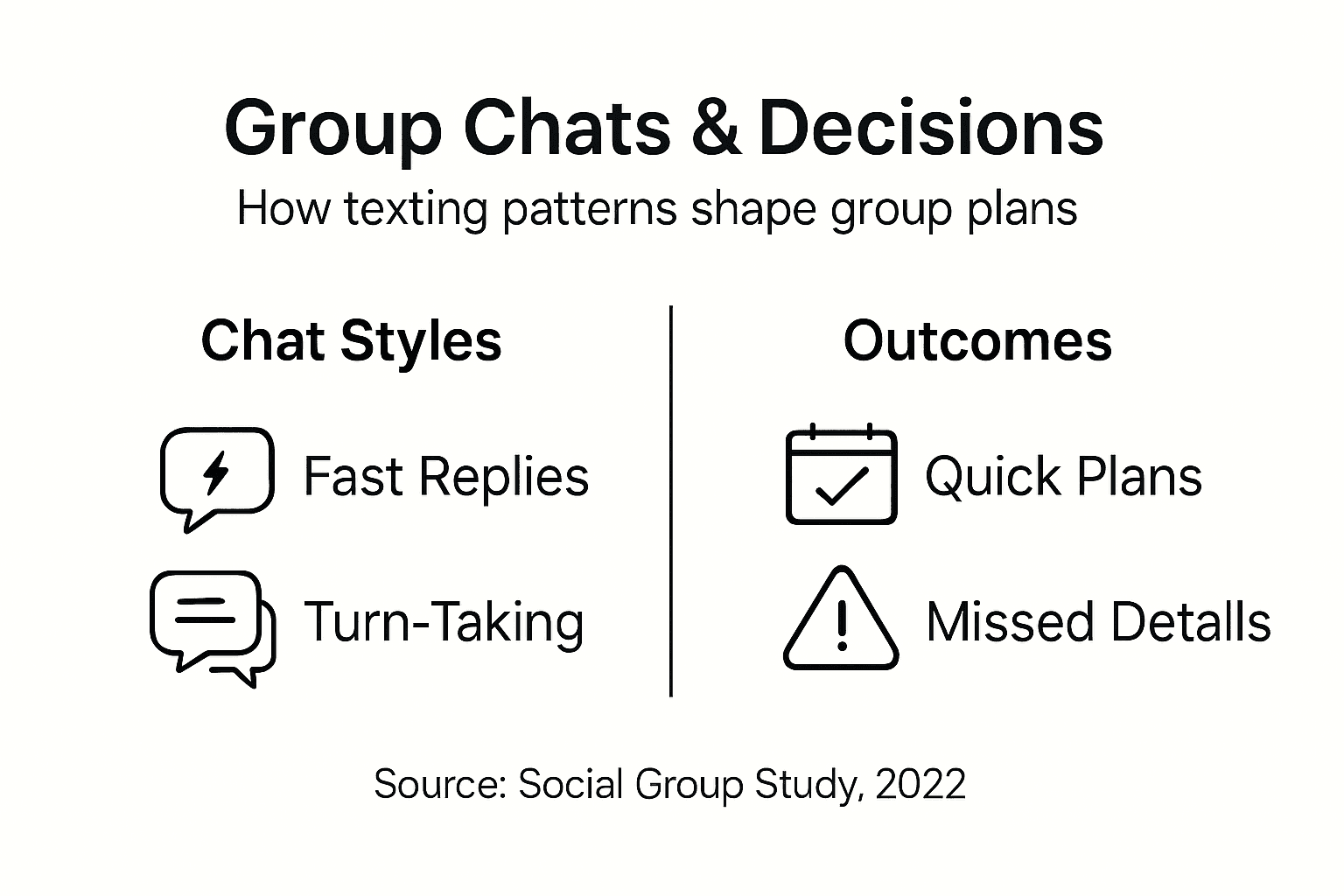
Actual coordination happens when group chats move from random conversation to structured planning. The difference between "hey we should hang soon" and "Saturday 7pm, who's in?" is massive. One is vague chatting. The other is logistics. Most friend groups struggle because they treat scheduling like casual banter, when it actually needs different communication patterns. Scheduling requires clarity, explicit responses, and confirmation. It needs people to state what they can do and what they cannot. It needs a moment where the group collectively says yes, this is happening. Group chat platforms support this better than pure social messaging because people can reference specific messages, tag individuals, and create threads around specific decisions. Yet many groups still let scheduling conversations get lost in the noise of jokes and life updates.
The mechanics of successful scheduling come down to how messages build on each other. Interactive and cohesive message patterns in professional group chats show that when people reference each other's messages and acknowledge what was said, coordination improves dramatically. This works in friend groups too. When someone proposes a time and explicitly tags or responds to people who previously said they were free, those people feel accountable. They know the proposal is directed at them. They know a response is expected. Compare that to a vague message sent into the void where people might miss it or assume it wasn't meant for them. The most successful groups also use consistent formats for scheduling. Instead of burying the question in paragraphs, they isolate it: "Pizza night Friday or Saturday?" People skim faster and respond more reliably. Some groups use numbered options to make yes-or-no responses foolproof. Others pin scheduling messages to keep them visible. The structure matters more than most people realize.
What derails scheduling conversations is ambiguity about response deadlines and decision rules. Groups need to know: Are we deciding right now or waiting for more input? Do we need everyone to respond or just a majority? What counts as confirmation? Some groups assume that if three people say yes, the plan is locked in. Others wait for explicit agreement from everyone who might show up. Some people think silence means yes while others think it means maybe. These mismatched expectations create chaos where someone shows up thinking the plan is set and someone else is still uncertain. The best approach is to state your expectations upfront. "Deciding in one hour, first response wins," or "Need 48 hours notice, respond by Sunday if you're coming." This removes guessing. It also prevents the common scenario where someone proposes something, gets one or two responses, and then the conversation dies because nobody knows if it's actually happening. Improving usability and providing positive feedback in group chats enhances engagement in scheduling activities. When someone confirms they're coming and others acknowledge it ("nice, see you then"), it reinforces that the plan is solid. That confirmation creates momentum. People feel better about committing when they see others committed too.
Scheduling also benefits from separating planning conversations from social ones. Some groups use separate channels or threads specifically for logistics. Others just signal when the tone is shifting. "Real quick, we need to nail down plans for next week" tells people to switch into decision mode. Without that signal, they keep chatting casually and miss the decision happening. The groups that master scheduling are usually the ones who treat it like a distinct activity within their chat, not just another conversation thread. They give scheduling the attention and structure it needs while keeping the fun, loose vibe alive everywhere else. That balance is possible. Social chat can stay spontaneous. Scheduling can become predictable and reliable.
To help you design effective group chats, here are key communication patterns that boost or hinder scheduling success:
| Pattern | Positive Effect | Negative Effect | Example Impact |
|---|---|---|---|
| Direct referencing | Increases accountability | Can lead to exclusion | Planning messages get responses |
| Sequential agreement | Builds momentum | Limits true options | Most agree with first response |
| Explicit deadlines | Confirms plans | May pressure some | Fast commitment from group |
| Vague messaging | Causes confusion | Stalls coordination | Plans remain undecided |
Pro tip: Create a scheduling format your group uses consistently (like "TIME OPTIONS: Saturday 7pm / Sunday 3pm. Reply with your pick by Friday 6pm") so people immediately recognize when a decision is happening and know exactly how to respond.
Common Pitfalls of Group Planning
Most friend groups fail at planning for predictable reasons. These aren't mysterious failures. They're patterns that repeat across different friend circles, different group sizes, and different activities. Once you recognize what goes wrong, you can actually fix it. The biggest pitfall is treating group planning like it happens automatically through casual chat. It doesn't. Plans need intention. They need someone to take the lead, propose specific options, and get explicit confirmation. Groups that wait for plans to emerge organically through conversation usually end up with nothing. Someone mentions wanting to hang. Someone else says "yeah, we should." Months pass. Nobody has actually coordinated anything because nobody took ownership of the planning process. The difference between groups that pull off hangouts and groups that don't often comes down to whether someone steps up and says "here's what we're doing, here's when, who's in?"
A second major pitfall is unclear expectations about availability. When someone says "any time works," they think they're being helpful. Actually, they're making planning harder because the person coordinating has no real information to work with. Are they genuinely free all weekend or just being polite? Would they prefer morning or evening? Will they bail at the last second if something better comes up? Vague responses and unclear communication about availability create bottlenecks. The coordinator can't make decisions because they don't know if people are actually committed. Groups also suffer from the diffusion of responsibility problem. When a group gets larger, individual accountability shrinks. Everyone assumes someone else will confirm details or follow up. So nobody does. Someone might have mentioned a plan in passing, but since ten people heard it casually, nobody thinks they need to actually confirm they're coming. Then half the people show up and half don't. Group size and diffusion of responsibility directly affect coordination failures. Smaller groups have better coordination because each person feels responsible. Larger groups fragment into confusion.
Message overload and unclear rules of engagement also wreck planning efforts. Some group chats move so fast that scheduling messages get buried instantly. Someone proposes pizza night in a chat where people send 50 messages per hour. The scheduling question disappears within minutes. Other chats have unclear norms about response speed. Does everyone need to respond immediately or can you check the chat once a day? Some people feel anxiety from unclear group chat rules and pressure to respond quickly while others don't notice the pace at all. When these expectations don't match, problems follow. Someone feels annoyed that their plan got ignored. Someone else feels harassed by constant notifications. A third person just isn't paying attention. Nobody communicated about how the group operates, so coordination falls apart. Groups also struggle with the plan fade problem, where enthusiasm dies out between proposal and execution. Someone floats an idea and gets positive reactions, so they assume it's locked in. But over the next few days, people get busy or forget. When the actual date arrives, nobody confirms attendance. The originator shows up thinking others will come. They don't. The plan wasn't really planned. It was just an idea that generated optimism but no actual commitment.
The solution to most planning pitfalls is structure, clarity, and one person taking ownership. That doesn't mean being bossy. It means being the person who sends the clear message: "We're doing dinner Saturday. Options are 6pm or 7pm. Reply with your pick by Friday." It means following up with people who haven't responded. It means confirming the final plan the night before. It means accepting that your friend group won't naturally coordinate without someone making it happen. The groups that actually pull off fun activities have typically assigned or naturally fallen into a "planner" role. Someone enjoys coordinating. They're not perfect at it, but they're reliable. That consistency is what transforms a chaotic chat into a group that actually hangs out.
Pro tip: Assign one person to be the planning lead for each hangout or rotate the responsibility so one person owns confirmation, deadlines, and final details instead of hoping everyone collectively coordinates.
Keys to Healthier, More Effective Chats
Transforming a chaotic group chat into one that actually functions well doesn't require overhauling everything. It requires intentional adjustments to how your group communicates. The healthiest group chats share common patterns that make both socializing and planning easier. They have clear rhythms. They acknowledge when someone contributes. They balance fun with function. They give people the information they need without overwhelming them. These chats feel good to participate in because people know what to expect and feel genuinely heard. Building this takes conscious effort at first, but once it becomes your group's normal pattern, coordination happens naturally.
One foundational key is establishing chat rhythm and clarity. Some groups have a norm of checking the chat once a day. Others expect constant engagement. Neither is wrong, but the group needs to know which one applies to them. When someone proposes plans, they can say "checking this tomorrow morning and deciding" or "need responses by tonight." This prevents the frustration where one person expects immediate responses and another thinks they have a week to think about it. Another critical element is balancing interactive, cohesive, and affective messages. Research shows that balanced emotional expression, explicit references, and social greetings create collaborative environments that support effective planning. That means your group chat shouldn't be purely transactional logistics. But it also shouldn't be so flooded with tangents that actual plans die. The sweet spot is acknowledging people ("hey, good point"), mixing in genuine emotional sharing ("that sounds fun, I need this"), and staying grounded in the actual coordination ("cool, so we're doing this Saturday"). Groups that do this naturally feel better to be in. People want to respond because they feel seen.
Another key factor is reducing cognitive overload while maintaining engagement. When a group chat moves at lightning speed with 100 messages per hour, people zone out or feel anxious about keeping up. When nothing ever happens, people forget the chat exists. Research on improving usability and optimizing chat rhythm suggests that managing the sensory input and pacing helps people stay engaged without burning out. Some groups naturally move slow because members are busy. Others move fast because everyone's online constantly. Whatever your group's pace, make it consistent. If you're a slow-chat group that suddenly needs to plan something, signal the shift: "hey, everyone check your phone, we're planning Saturday." If you're a fast-chat group, acknowledge that scheduling messages might get buried and either pin them or send them in a separate thread. This small awareness prevents decisions from getting lost in noise. You can also reduce cognitive load by being selective about what goes in the main chat. Save tangential conversations for threads so the main feed stays focused. Use formatted options for planning (numbered lists, clear yes-or-no choices) so people can respond quickly without rereading paragraphs.
The final key is creating accountability without creating pressure. Healthy groups find ways to make plans feel real without being anxiety-inducing. When someone confirms they're coming and others like the message or respond, it creates momentum. That's better than silence that leaves everyone uncertain. Some groups use emoji reactions as acknowledgment. Others expect brief text responses. The mechanism matters less than the fact that something signals "yes, I'm in." Additionally, having a designated planner or rotating who owns each hangout creates clear responsibility without dumping it on one person forever. The building stronger bonds through healthier group chat dynamics happens when people feel trusted to follow through and supported when they do. You're not trying to police people or enforce rigid rules. You're creating conditions where people naturally want to show up and participate.
Pro tip: Establish one simple norm for your group (like "confirm by Friday for weekend plans" or "planning messages get a pin so they don't get buried") and stick with it consistently so everyone knows exactly how your chat operates.
Simplify Your Group Chat Planning With Groop
Managing group chat dynamics can make friend planning feel overwhelming. The article highlights common challenges like unclear scheduling, ignored messages, and the struggle to shift from casual chatting to focused coordination. If you recognize the frustration of endless back-and-forth without concrete plans or the anxiety caused by confusing logistics, you are not alone. Groop offers a tailored solution that respects your group's unique vibe while turning chaotic coordination into smooth decision-making.
Discover how Groop’s lightweight scheduling tool directly addresses these pain points by providing clear, manageable options for meetups. With features designed to line up availability, expose conflicts, and prompt action without pressure, your friend group can transform scattered conversations into easy hangouts. Make your next plan effortlessly effective by visiting Groop Labs. For a practical take on harmonizing social chat and scheduling, explore how Groop balances interaction and logistics at https://groop-labs.com. Start turning group chat chaos into coordinated fun today.
Frequently Asked Questions
What are group chat dynamics?
Group chat dynamics refer to the interactions, behaviors, and emotional exchanges that happen among multiple people in a messaging space. They affect participation and create different 'vibes' within the chat.
How do understanding group chat dynamics help with planning?
Understanding group chat dynamics helps identify how people communicate, which influences the effectiveness of planning. It allows you to adapt your approach based on the chat's emotional tone and communication patterns.
What types of group chats are there?
There are several types of group chats, including core friend circles (close friends), activity-based groups (focused on hobbies), neighborhood or situational chats (based on context), and loosely connected networks (people who don’t know each other well).
What common pitfalls do friend groups face when planning?
Common pitfalls include treating planning as an automatic process, unclear expectations about availability, diffusion of responsibility, message overload, and the plan fade problem where enthusiasm diminishes before execution.