
Articles
How to plan group outings: simple steps for stress-free fun
Learn how to plan group outings with simple, stress-free steps. From picking activities to managing budgets, make every hangout easy and fun for everyone.

How to plan group outings: simple steps for stress-free fun

TL;DR:
- Use polls and inclusive activities to ensure group preferences and better attendance.
- Plan budgets and timing carefully, prioritizing affordability and short, engaging events.
- Organize logistics with backup plans and effective communication to keep outings smooth and fun.
Getting a group of friends to agree on anything can feel like herding cats through a revolving door. Someone wants tacos, someone else wants a hike, and three people haven't even read the last 47 messages in the group chat. Research confirms that nearly half of college students skip campus events entirely, which means the planning experience itself is often the barrier. The good news? With a few practical steps, you can turn that chaotic back-and-forth into a smooth, enjoyable process that actually gets people showing up and having a great time.
Table of Contents
- Start strong: Gauge interests and pick inclusive activities
- Plan your budget and timing: Keep outings affordable for everyone
- Organize logistics: Locations, weather plans, communication
- Create connections: Make outings fun, memorable, and inclusive
- Beyond the checklist: Why the best outings focus on flexibility and connection
- Get your group together—easier than ever
- Frequently asked questions
Key Takeaways
| Point | Details |
|---|---|
| Use digital polls | Polling group members in chat quickly surfaces top activity picks and saves planning time. |
| Plan with a budget | Allocating costs for venue, food, and activities makes outings affordable for everyone. |
| Always have backups | Backup locations and flexible plans reduce stress if weather or attendance changes. |
| Mix activities for all | Combining different personality-friendly options ensures everyone feels welcome and engaged. |
Start strong: Gauge interests and pick inclusive activities
With a clear sense of why planning usually frustrates people, let's see how you can make step one a smooth success.
The single biggest reason group outings fall apart before they even start is that nobody really asked what everyone wanted. One person makes a decision, half the group feels lukewarm about it, and attendance quietly drops. Skipping this step is what turns a promising hangout into a last-minute cancellation.
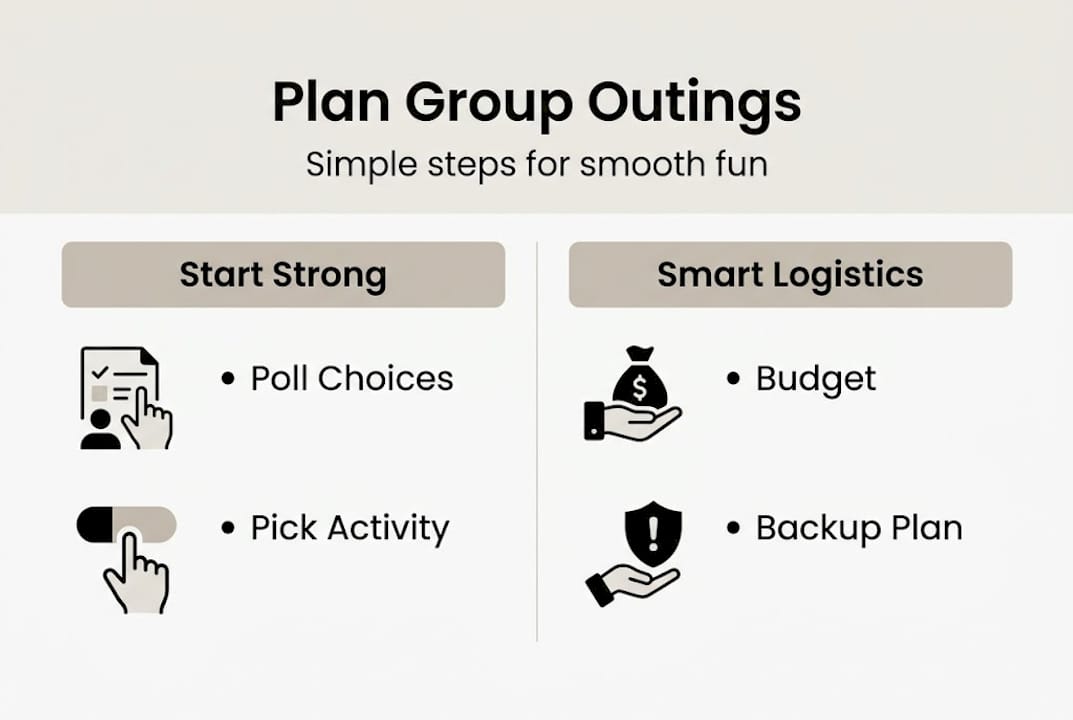
The fix is simple: use a poll. Polls in a group chat can efficiently surface everyone's preferences without anyone having to argue their case. You get real data fast, and people feel heard before the plan is even set. Pairing a quick poll with an open chat moment for comments gives you the best of both worlds: speed and nuance.
When it comes to choosing the actual activity, think inclusive first. Not everyone in your squad is an extreme sports enthusiast or a night-owl clubber. Low-pressure recurring events lead to more happiness for college students, which means the chill, low-stakes hangout often wins over the elaborate production.
Here's a quick comparison to help you match the activity to your group's energy:
| Activity type | Best group size | Energy level | Typical cost |
|---|---|---|---|
| Trivia night | 4 to 10 | Low | $ |
| Hiking or nature walk | 3 to 12 | Medium | Free |
| Cooking or potluck | 4 to 8 | Low to medium | $ |
| Escape room | 4 to 8 | High | $$$ |
| Movie night at home | Any | Very low | Free to $ |
| Game tournament | 4 to 12 | Medium | $ |
Some of the best budget-friendly ideas that work for almost any group include:
- Trivia nights at a local bar or campus venue
- Scavenger hunts around your neighborhood or campus
- Potluck dinners where everyone brings a dish
- Outdoor movie screenings in a backyard or park
- Board game or card game tournaments at someone's place
- Campus resource events like free concerts or sports games
Using group chat apps for planning makes the polling and discussion process much smoother. And if you want to know what features actually matter in those tools, checking out the features of group chat apps is a great starting point.
Pro Tip: Run your poll for no more than 24 hours. Longer polls create decision fatigue and delay momentum. Set a deadline and commit to the winner.
Plan your budget and timing: Keep outings affordable for everyone
Once you've chosen activities, making them affordable and well-timed keeps everyone happy.
Money is the silent killer of group plans. Someone suggests a fancy rooftop dinner, two people quietly panic about their bank account, and suddenly nobody RSVPs. Getting budget expectations on the table early removes that awkward tension and keeps the whole group on board.
A solid starting framework for group event spending looks like this:
| Category | Suggested share of total budget |
|---|---|
| Venue | 30 to 40% |
| Food and drinks | 30% |
| Activities and entertainment | 15% |
| Transportation | 10% |
| Contingency buffer | 10% |
According to event planning research, venue costs 30 to 40% of a typical college event budget, with food at 30% and activities at 15%. Using potlucks or free outdoor spaces can dramatically cut those numbers down.
Here's a simple process to get your group aligned on money:
- Set a per-person cap before you finalize any activity. Ask everyone what feels comfortable.
- Collect contributions digitally using apps like Venmo or Splitwise so nobody has to chase anyone for cash.
- Prioritize free or low-cost venues like parks, campus spaces, or someone's backyard.
- Assign a budget tracker so one person keeps an eye on spending in real time.
- Leave that 10% buffer untouched until the day of the event for surprise costs.
Timing matters just as much as money. Short social events improve social connections and performance, which means you don't need a full-day commitment to make an impact. Brunches, early evening hangouts, and two-hour focused activities tend to get better turnout than all-day events that require people to clear their entire schedule.
For more detailed help on the logistics side of things, the group outing logistics tips guide breaks it down step by step.
Pro Tip: Always build your budget around the person with the tightest wallet. A great outing is one everyone can actually attend, not just the ones who can afford it.
Organize logistics: Locations, weather plans, communication
With money and timing covered, smart logistics make sure nothing derails your plan.

Even the best activity idea can collapse under the weight of poor logistics. Venue too small, no parking, rain with no backup plan, and suddenly your fun outing becomes a stressful scramble. Getting the details right ahead of time is what separates a smooth hangout from a disaster story.
When choosing a venue, think about these essentials:
- Group size fit: Book a space that comfortably holds your expected headcount, with a little room to spare.
- Accessibility: Make sure the location works for everyone, including those without a car or with mobility considerations.
- Book early: Popular spots fill up fast, especially on weekends. Reserving at least a week ahead avoids disappointment.
- Outdoor vs. indoor: If you're going outside, always have an indoor backup ready.
"Having a backup location and flexible venues prevents last-minute letdowns." Knowing your plan B before you need it is the difference between a minor hiccup and a canceled outing.
Weather and attendance surprises are the two most common curveballs. A backup location and flexible venues prevent last-minute letdowns, so always identify your indoor alternative before the day arrives. For attendance, plan your logistics around a minimum headcount rather than the optimistic maximum. That way, the experience still works even if a few people bail.
Communication is where a lot of groups lose the thread. A dedicated planning channel or a scheduling workflow for group outings keeps everyone on the same page without flooding the main group chat. Send one clear message with the who, where, when, and what-to-bring details. No one should have to scroll through 200 messages to find the address.
For ongoing coordination, tools that help you manage group outings efficiently can handle reminders, headcounts, and updates automatically, so you're not the one sending five follow-up texts.
Create connections: Make outings fun, memorable, and inclusive
With logistics sorted, making the experience fun and personal ensures group outings leave everyone happy and eager for more.
The whole point of getting together isn't just to check a box. It's to actually enjoy each other's company and build something worth remembering. A little intentional effort goes a long way toward making that happen.
Small, focused events offer the highest "luck yield" for forming real connections. That means a tight, well-organized two-hour hangout with a clear activity beats a sprawling, unstructured all-day event almost every time. Focus creates energy.
Here's a simple process for building connection into your outing:
- Open with an icebreaker that's low-stakes and fun, like a quick trivia round or a "two truths and a lie" moment.
- Use food as a connector. Sharing a meal or snacks naturally gets people talking and relaxed.
- Create a shared moment everyone can reference later, like a group photo, a funny challenge, or a collaborative playlist.
- Rotate small group conversations so people aren't stuck in the same two-person bubble all night.
- Wrap up with a highlight round where everyone shares their favorite moment from the outing.
- Send a short feedback check-in after the event to ask what people loved and what they'd change.
That last step is one most groups skip entirely. Delegating roles and inviting post-event feedback improves the next gathering significantly. It also makes people feel like their opinion shapes the group's future plans, which boosts buy-in and attendance over time.
For ideas on simplifying social planning so the coordination itself doesn't overshadow the fun, there are some great frameworks worth exploring.
Pro Tip: Mix one introvert-friendly element (like a quiet game corner or a chill playlist zone) with one extrovert-friendly element (like a group challenge or open mic moment). Everyone gets a space where they can thrive.
Beyond the checklist: Why the best outings focus on flexibility and connection
We've covered the nuts and bolts. Now here's a perspective most planning guides miss entirely.
There's a real temptation to over-engineer group outings. You find the perfect venue, nail the budget, create a color-coded schedule, and then wonder why the energy still feels flat. The truth is, rigid planning can actually get in the way of connection. When every minute is accounted for, there's no room for the spontaneous conversation or the unexpected moment that becomes the story everyone tells for years.
The best outings we've seen combine just enough structure to prevent chaos with enough breathing room for things to unfold naturally. That means locking in the essentials: time, place, and activity. Then letting the rest flow.
Smart digital tools, including apps like Grooop, save real time on the logistics side. But the goal was never a perfect schedule. It was always meaningful time together. When you use top group planning strategies to handle the boring coordination, you free up your energy for what actually matters: showing up present and enjoying your people.
The groups that keep showing up for each other aren't the ones with the most elaborate plans. They're the ones where everyone felt seen, heard, and genuinely welcome.
Get your group together—easier than ever
If you're ready to make your next group outing the easiest one yet, Groop Labs was built exactly for this.
Groooop takes the back-and-forth out of planning by automatically lining up availability, surfacing conflicts, and giving your group simple, clear choices to pick from. No endless polls. No 200-message threads. Just a lightweight, pressure-free way to get everyone on the same page fast. Whether you're organizing a weekly hangout, a study session, or a spontaneous weekend outing, plan your next outing with Groop Labs and see how much easier coordination can actually feel. Your group deserves a planning experience that's as fun as the outing itself.
Frequently asked questions
What is the easiest way to decide on an activity for a group outing?
Use a poll in your group chat to quickly see what everyone prefers, then pick the most popular and inclusive option. Polls surface preferences efficiently and cut down on back-and-forth arguments.
How do you handle last-minute no-shows or bad weather?
Always plan for a minimum attendee count and have a backup indoor location ready before the day arrives. Flexible venues and backup locations prevent last-minute letdowns from derailing the whole outing.
How much should I budget for a typical group outing?
Plan for venue costs to take up about 30 to 40% of your total, food around 30%, activities 15%, and keep a 10% contingency for surprises. Potlucks and outdoor spaces can significantly reduce those numbers.
What are fun, low-cost group outing ideas for college students?
Trivia nights, scavenger hunts, potlucks, movie nights, and game tournaments are all popular and budget-friendly options that work for almost any group size or energy level.