
Articles
Group logistics vs social decisions: coordinate friends easily
Discover the key differences between group logistics and social decisions in friend planning. Learn how modern tools and strategies help young adults coordinate hangouts efficiently in 2026.

Group logistics vs social decisions: coordinate friends easily

You text your group chat proposing Saturday brunch, and 20 messages later you still have no plan. Half the crew debates whether brunch is too basic while others argue over timing. This chaos happens because friend groups mix social vibes with practical logistics, creating planning paralysis. When you understand the difference between coordinating schedules and making social choices, planning becomes dramatically simpler. This article breaks down group logistics versus social decisions, showing you exactly how to cut through the noise and organize hangouts without the headache.
Table of Contents
- Understanding Group Logistics And Social Decisions In Casual Friend Groups
- Why Social Decisions Dominate Teenage And Young Adult Group Planning
- How Modern Tools Handle Group Logistics To Ease Planning Headaches
- Balancing Social Dynamics And Logistics For Smooth Group Planning
- Discover Groop Labs: Your Partner For Hassle-Free Group Coordination
- Frequently Asked Questions
Key takeaways
| Point | Details |
|---|---|
| Logistics handle coordination | Scheduling, RSVPs, and venue selection are practical tasks separate from social dynamics |
| Social decisions dominate teens | Peer influence and group harmony often outweigh pure efficiency in young adult planning |
| Modern tools reduce friction | Apps automate scheduling and tracking, cutting planning time significantly |
| Balance both for success | Combining social awareness with logistical tools creates smooth, enjoyable coordination |
Understanding group logistics and social decisions in casual friend groups
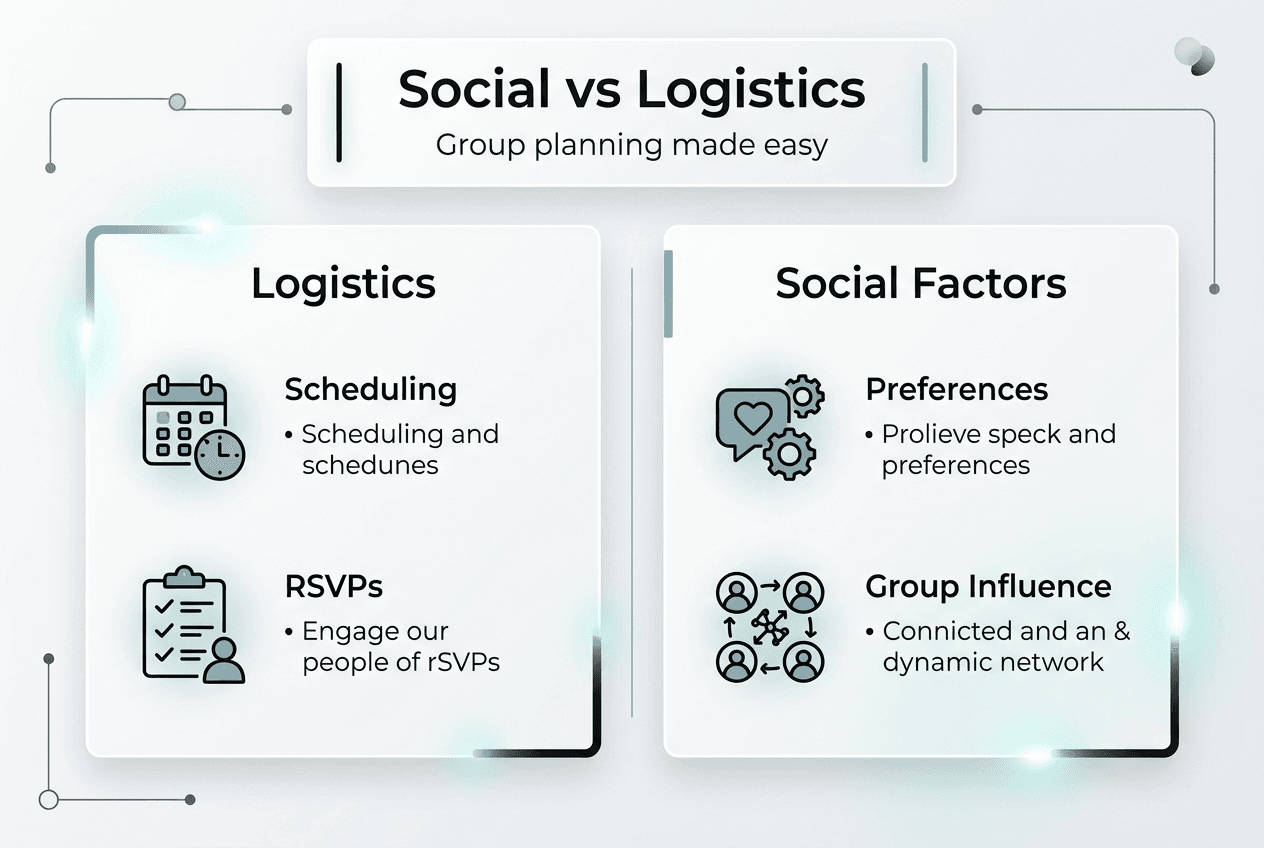
Group logistics involve practical coordination like scheduling, RSVPs, and location selection, while social decisions encompass relational dynamics such as cooperation, peer influence, and maintaining group harmony in casual friend groups of young adults and teens. These two categories constantly overlap, but recognizing the distinction transforms how you approach planning.
Group logistics cover the nuts and bolts: checking calendars, confirming who can attend, picking a time that works, and selecting a venue. These tasks require information gathering and organization. Social decisions involve the human element: choosing activities everyone enjoys, respecting individual preferences, navigating peer pressure, and keeping the vibe positive. When your squad debates whether to hit the arcade or grab pizza, that's a social decision. When you figure out who's free Friday versus Saturday, that's logistics.
Most planning breakdowns happen when these categories collide. Someone suggests a plan, but the group starts debating whether it sounds fun before checking if anyone can even make it. Calendar mismatches create frustration. Different priorities cause tension. You might have three people enthusiastically voting for bowling while two others stay silent because they feel pressured to agree. Meanwhile, nobody has actually confirmed availability.
Common logistical tasks include:
- Syncing multiple calendars to find overlapping free time
- Tracking who responded yes, no, or maybe
- Sharing location details and directions
- Managing cost splitting and payment coordination
- Sending reminders as the event approaches
Social decision aspects show up differently:
- Choosing activities based on what the group finds acceptable
- Navigating peer influence when preferences conflict
- Maintaining relationships through inclusive planning
- Balancing individual desires with group consensus
- Preserving the squad's overall vibe and energy
Here's the frustrating part: even when you have excellent logistical tools, social factors often trigger lengthy group chats. Your scheduling app might show everyone's availability perfectly, but the conversation spirals into debating whether the chosen activity is cool enough. Understanding best practices for social groups helps you recognize when you're stuck on social dynamics versus actual coordination problems.
"The hardest part of planning isn't finding a time. It's getting everyone to commit without feeling like they're settling or being pressured into something they don't want."
This insight explains why friend group planning feels harder than work meetings. Professional coordination focuses purely on logistics, but casual friends navigate complex social terrain simultaneously.
Why social decisions dominate teenage and young adult group planning
Teens and young adults prioritize social factors like peer influence and uncertainty in decisions, often outweighing pure logistical efficiency; adolescents show higher susceptibility to social information under uncertainty. Brain development during these years creates heightened sensitivity to peer opinions and social rewards, fundamentally shaping how groups coordinate.
Adolescent brains are wired to care intensely about social standing and peer acceptance. The reward centers light up stronger for social validation than for adults. This biological reality means your friend group naturally weighs social harmony more heavily than calendar efficiency. When planning conflicts arise, preserving relationships often trumps finding the optimal time slot.
Key social factors shaping teenage and young adult group decisions include:
- Peer pressure creates invisible boundaries around acceptable choices
- Uncertainty about preferences makes people defer to louder voices
- Identity formation ties personal choices to group membership
- Fear of exclusion drives agreement even when preferences differ
- Social comparison influences what activities feel worthwhile
Research reveals teens are actually more utilitarian in individual decisions but become heavily socially influenced in group contexts. You might efficiently plan your own schedule, but when coordinating with friends, social calculations dominate. Will this choice make me look boring? Does everyone actually want this or are they just being polite? What if I suggest something and nobody likes it?
This social emphasis explains why logistical efficiency often loses. Your group might spend 45 minutes debating restaurant options when a simple poll could decide in 30 seconds. The extended discussion isn't really about food logistics. It's about reading social cues, gauging enthusiasm, and ensuring nobody feels left out or pressured.

Social harmony frequently trumps logistical optimization in outcomes. You'll accept a less convenient meeting time if it means avoiding conflict. You'll agree to an activity you're lukewarm about because everyone else seems excited. These choices prioritize relationship maintenance over personal preference or schedule efficiency, which makes perfect sense for casual friend groups where the social bond matters more than any single hangout.
Pro Tip: Before jumping into planning tools, acknowledge the social context first. Ask your group what vibe they want and whether everyone genuinely likes the proposed activity. This simple step prevents logistical efficiency from steamrolling social needs, keeping coordination fun rather than mechanical. Tools work best when they support social decisions rather than trying to replace them, so understanding key features of group chat apps helps you pick platforms that respect both dimensions.
"The best planning happens when you separate 'what should we do' from 'when can we do it.' Solve the social question first, then let tools handle the logistics."
How modern tools handle group logistics to ease planning headaches
Tools like SameTeam and CoHost enable efficient logistics by handling RSVPs, shared calendars, and organized chats, reducing lengthy discussions; designed for friend groups planning events. These platforms recognize that casual coordination needs different features than professional project management, focusing on simplicity and social context.
SameTeam offers shared calendars where everyone adds their availability, automatic RSVP tracking that shows who's in or out, and topic-based chat threads that keep conversations organized. CoHost provides similar coordination features with an emphasis on visual planning interfaces and quick decision making. Both apps aim to extract the logistical heavy lifting from group chats, leaving more space for the fun social banter.
| Feature | SameTeam | CoHost | Traditional Group Chat | | --- | --- | --- | | RSVP Tracking | Automated with reminders | Visual yes/no/maybe interface | Manual counting in messages | | Shared Calendar | Syncs across members | Availability overlay view | Screenshot sharing chaos | | Chat Organization | Topic threads | Event-specific conversations | Everything mixed together | | Ease of Use | Moderate learning curve | Intuitive mobile-first design | Immediate but chaotic | | Social Focus | Balanced logistics and chat | Heavy social context | Pure conversation |
These apps reduce specific coordination pain points that plague friend groups. No more scrolling through 50 messages to find who said yes. No more creating new polls every time someone's availability changes. No more losing track of the final decision because it got buried under memes and off-topic jokes.
Key benefits of automating scheduling and organizing include:
- Cutting planning time from hours to minutes for routine hangouts
- Reducing stress by providing clear visibility into who's available
- Preventing double bookings through integrated calendar views
- Minimizing repetitive questions about basic details
- Creating accountability through transparent RSVP tracking
- Preserving group chat flow for actual social interaction
When logistics move to dedicated tools, your main group chat stays fun. You're not constantly interrupting conversations to ask "wait, are we meeting at 6 or 7?" The social space remains social while coordination happens efficiently in the background. This separation respects both the need for smooth logistics and the desire to maintain your group's natural communication style.
Pro Tip: Choose mobile-first apps with minimal setup friction for your group structure. If a tool requires everyone to create detailed profiles or learn complex features, adoption will fail. The best platforms let you start coordinating within 60 seconds of downloading, matching the spontaneous energy of casual friend groups. Exploring Groop.cc alternatives and understanding hassle-free group apps benefits reveals how different platforms balance simplicity with functionality.
The right tool becomes invisible infrastructure. You stop thinking about the planning mechanism and focus on the actual hangout. That's when coordination truly becomes effortless.
Balancing social dynamics and logistics for smooth group planning
Edge cases include decision fatigue in planning, such as 20 exchanges for a date, cancellations, and balancing individual costs with group prosocial tendencies; teens weigh personal costs, relationships, and identity. Real-world group planning involves navigating these complications while maintaining both efficiency and social harmony.
Typical planning problems that derail friend groups:
- Decision fatigue from endless back-and-forth discussions
- Last-minute cancellations that force replanning
- Conflicting individual schedules and priorities
- Budget mismatches creating awkward money conversations
- Dominant personalities overshadowing quieter members
- Enthusiasm gaps where some care more than others
| Planning Challenge | Logistical Contributor | Social/Prosocial Factor |
|---|---|---|
| Decision Fatigue | Too many options, no clear process | Fear of choosing wrong thing, wanting consensus |
| Cancellations | Schedule conflicts, poor tracking | Avoiding confrontation, overcommitting to please |
| Budget Issues | Different financial situations | Not wanting to seem cheap or exclude friends |
| Participation Gaps | Availability mismatches | Peer pressure, identity signaling through attendance |
Balancing group needs with individual preferences requires intentional strategies. Start by establishing simple communication norms: one person proposes a specific plan rather than open-ended "what should we do?" questions. Set realistic deadlines for responses so planning doesn't drag indefinitely. Respect no answers without guilt-tripping, which reduces fake yeses that lead to cancellations.
Communication norms and mutual respect enhance social harmony alongside logistics. When your group agrees that it's okay to say "that doesn't work for me" without elaborate explanations, planning becomes honest. When you normalize proposing alternatives instead of just vetoing ideas, coordination stays constructive. These social agreements make logistical tools more effective because people use them authentically.
Adjusting tools and conversations to fit group personality matters enormously. A tight squad of five close friends needs different coordination than a loose network of 15 acquaintances. Small groups might thrive with simple polls and shared notes, while larger networks benefit from structured RSVP systems. Match your approach to your group's actual dynamics rather than forcing a one-size-fits-all solution. Learning how group planning apps reduce stress and discovering why managing friend group events matters helps you customize your coordination strategy.
Pro Tip: Set simple roles and decision protocols to minimize overload and keep planning fun. Rotate who initiates plans each month so the burden doesn't fall on one person. Establish a "proposer decides" rule where whoever suggests the hangout gets final say on logistics after gathering input. These lightweight structures prevent analysis paralysis while respecting everyone's voice.
The sweet spot balances efficiency with inclusion. You want planning that's quick enough to not feel like work but thorough enough that everyone feels heard. When you nail this balance, coordination becomes almost invisible and your group spends energy on enjoying time together rather than organizing it.
Discover Groop Labs: your partner for hassle-free group coordination
Planning shouldn't be harder than the actual hangout. Groop Labs built Grooop specifically for casual friend groups who want seamless coordination without the chaos of endless group chat discussions. The mobile app combines RSVP tracking, availability alignment, and conflict surfacing in one lightweight interface designed for how young adults and teens actually communicate.
Grooop recognizes that your squad needs logistics handled efficiently while preserving the social vibe that makes your group special. The platform automates the boring coordination tasks like finding overlapping free time and tracking responses, leaving you free to focus on the fun social decisions about what to actually do together. Whether you're organizing study sessions, weekend adventures, or spontaneous coffee runs, Grooop keeps planning pressure-free and natural.
Visit Groop Labs to discover how the right coordination layer transforms your group chat from planning nightmare into pure social connection. The app works alongside your existing communication, adding just enough structure to eliminate friction without feeling mechanical. Try it for your next hangout and experience coordination that finally matches your group's energy.
Frequently asked questions
What are group logistics versus social decisions?
Group logistics cover practical coordination tasks like checking calendars, confirming attendance, selecting venues, and managing event details. Social decisions involve the relational dynamics of choosing activities, navigating peer influence, maintaining group harmony, and respecting individual preferences. Logistics ask "when and where can we meet?" while social decisions ask "what should we do and will everyone enjoy it?"
Why do teens prioritize social decisions over logistics when planning?
Adolescent brain development creates heightened sensitivity to peer opinions and social rewards, making relationship preservation feel more urgent than schedule efficiency. Teens weigh identity, peer acceptance, and group belonging heavily when coordinating, often accepting logistical inconvenience to maintain social harmony. This biological and psychological reality means social factors naturally dominate planning conversations even when efficient tools are available.
How do tools like SameTeam and CoHost improve group planning?
These platforms automate RSVP tracking, provide shared calendar views, and organize conversations by topic, eliminating the need to scroll through mixed group chats for planning details. They extract logistical coordination into dedicated interfaces, reducing planning time and preventing information from getting lost. By handling the mechanical tasks, these tools let your main group chat stay focused on social interaction and relationship building.
What can I do to reduce decision fatigue in my friend group?
Assign simple rotating roles so one person proposes specific plans rather than open-ended questions, and establish clear response deadlines to prevent endless discussion. Use tools that automate logistics like availability checking and RSVP tracking. Keep communication norms clear by normalizing honest no answers and limiting over-discussion of minor details, which preserves energy for decisions that actually matter.