
Articles
Hassle-Free Group Apps: Stress-Free Social Planning
Discover hassle-free group apps for easy scheduling, clear logistics, and relaxed decision-making. Learn features, key benefits, and common pitfalls.

Hassle-Free Group Apps: Stress-Free Social Planning

Trying to get a group of friends together often spirals into endless chats and confusion, especially for college students balancing busy schedules across different regions in the United States. Traditional group messages can be chaotic, making planning feel like more work than fun. Thanks to dedicated group coordination apps, organizing hangouts becomes quicker and less stressful. These platforms help friends avoid common misconceptions, making group decisions smoother so everyone spends less time planning and more time connecting.
Table of Contents
- Defining Hassle-Free Group Apps and Misconceptions
- Scheduling Tools and Social Coordination Features
- How Group Apps Preserve Social Dynamics
- Comparing Group Apps to Traditional Chat Methods
- Mistakes to Avoid With Group Scheduling Platforms
Key Takeaways
| Point | Details |
|---|---|
| Hassle-Free Group Apps Simplify Planning | These apps are designed to streamline social coordination, making planning enjoyable and reducing stress through intelligent design. |
| Intelligent Scheduling Enhances Decision Making | Modern scheduling tools automate availability matching and conflict resolution, allowing for efficient group planning and less manual effort. |
| Social Dynamics are Preserved | Group apps maintain emotional connectivity and facilitate informal interactions, enhancing social bonds rather than replacing real-life connections. |
| Avoid Common Scheduling Pitfalls | Users should actively engage with these platforms, be aware of individual constraints, and simplify workflows to maximize effectiveness. |
Defining Hassle-Free Group Apps and Misconceptions
Group coordination apps represent a modern solution to the age-old challenge of organizing social activities. Unlike traditional group chats that become overwhelming and chaotic, these specialized platforms aim to simplify social planning through intelligent design and user-friendly interfaces.
Many people misunderstand the core purpose of hassle-free group apps, often confusing them with standard messaging platforms. Understanding user preconceptions about AI tools is crucial for recognizing their true potential. These apps are not just another communication channel, but strategic coordination systems designed to reduce planning stress.
Key characteristics of effective group apps include:
- Intuitive availability matching
- Simplified decision-making processes
- Minimal back-and-forth communication
- Automated conflict resolution
- Personalized group preferences tracking
Contrary to common misconceptions, these apps don't replace human interaction - they enhance it. They provide a structured framework that allows friends to spend less time planning and more time actually enjoying each other's company. By streamlining logistical challenges, group apps create space for more meaningful social connections.
Pro tip: When evaluating a group planning app, prioritize platforms that offer quick consensus building and minimize manual coordination efforts.
Scheduling Tools and Social Coordination Features
Modern group scheduling tools have transformed the way friends and colleagues plan activities, moving far beyond traditional communication methods. These sophisticated platforms leverage intelligent algorithms to simplify the complex process of finding mutually convenient times and coordinating social gatherings. Real-time group scheduling innovations have dramatically reduced the time and energy typically spent negotiating meeting times.
Effective social coordination features typically encompass several critical components that streamline group planning:
- Automatic time zone conversion
- Integrated availability matching
- Preference prioritization
- Conflict detection and resolution
- Easy voting and consensus mechanisms
- Quick invitation and response tracking
Intelligent Scheduling Dynamics go beyond simple calendar comparisons. These tools analyze participants' schedules, preferences, and historical availability patterns to suggest optimal meeting times. By understanding individual constraints and group dynamics, advanced scheduling platforms can recommend windows of opportunity that might be overlooked during manual coordination.
The real power of these tools lies in their ability to transform group planning from a stressful negotiation into a seamless, collaborative experience. Instead of endless text message chains and email threads, users can now make decisions efficiently, preserving social energy for the actual event rather than its planning.

Pro tip: Choose a scheduling tool that offers flexible customization and integrates smoothly with your group's existing communication channels.
How Group Apps Preserve Social Dynamics
Group communication technologies have fundamentally transformed how social networks maintain their intricate dynamics, moving beyond simple messaging to become sophisticated interaction platforms. Group communication patterns reveal complex social interactions that help preserve the nuanced relationships within friend groups and social circles.
These digital platforms support social dynamics through several critical mechanisms:
- Maintaining emotional connectivity
- Facilitating continuous lightweight interactions
- Preserving informal group hierarchies
- Supporting contextual communication
- Enabling subtle social signaling
- Reducing planning friction
Social Network Preservation happens through intelligent design that mimics natural human communication patterns. Group apps understand that social interactions aren't just about exchanging information, but about maintaining complex interpersonal connections. They provide spaces where friends can share experiences, inside jokes, and subtle social cues that traditionally occurred in physical gatherings.
By reducing logistical barriers, these tools actually enhance social bonds rather than replacing them. They create shared digital spaces that feel natural and intuitive, allowing groups to stay connected without the exhausting overhead of constant manual coordination. The technology becomes invisible, letting social dynamics flow organically.
Pro tip: Choose group apps that feel like an extension of your social circle, not a rigid communication tool.
Comparing Group Apps to Traditional Chat Methods
Traditional group chat methods have long been the default for social coordination, but they come with significant limitations that modern group apps are designed to overcome. Specialized coordination apps reduce communication overhead dramatically, transforming how friends and colleagues plan and interact.
Key differences between traditional chat methods and advanced group apps include:
- Automated scheduling capabilities
- Integrated calendar synchronization
- Built-in polling and voting mechanisms
- Intelligent conflict resolution
- Contextual decision-tracking
- Seamless reminder systems
Communication Efficiency represents the most striking difference between traditional messaging and purpose-built group coordination platforms. While standard group chats become cluttered with endless message threads, modern apps create structured environments that minimize decision-making friction. They transform chaotic conversations into streamlined planning experiences, preserving social energy that would otherwise be exhausted by logistical back-and-forth.
Traditional chat methods require manual tracking, constant scrolling, and individual memory management. In contrast, group apps act like intelligent assistants, automatically surfacing critical information, maintaining context, and helping participants make collective decisions with minimal cognitive load. The technology becomes an invisible facilitator, not another communication burden.
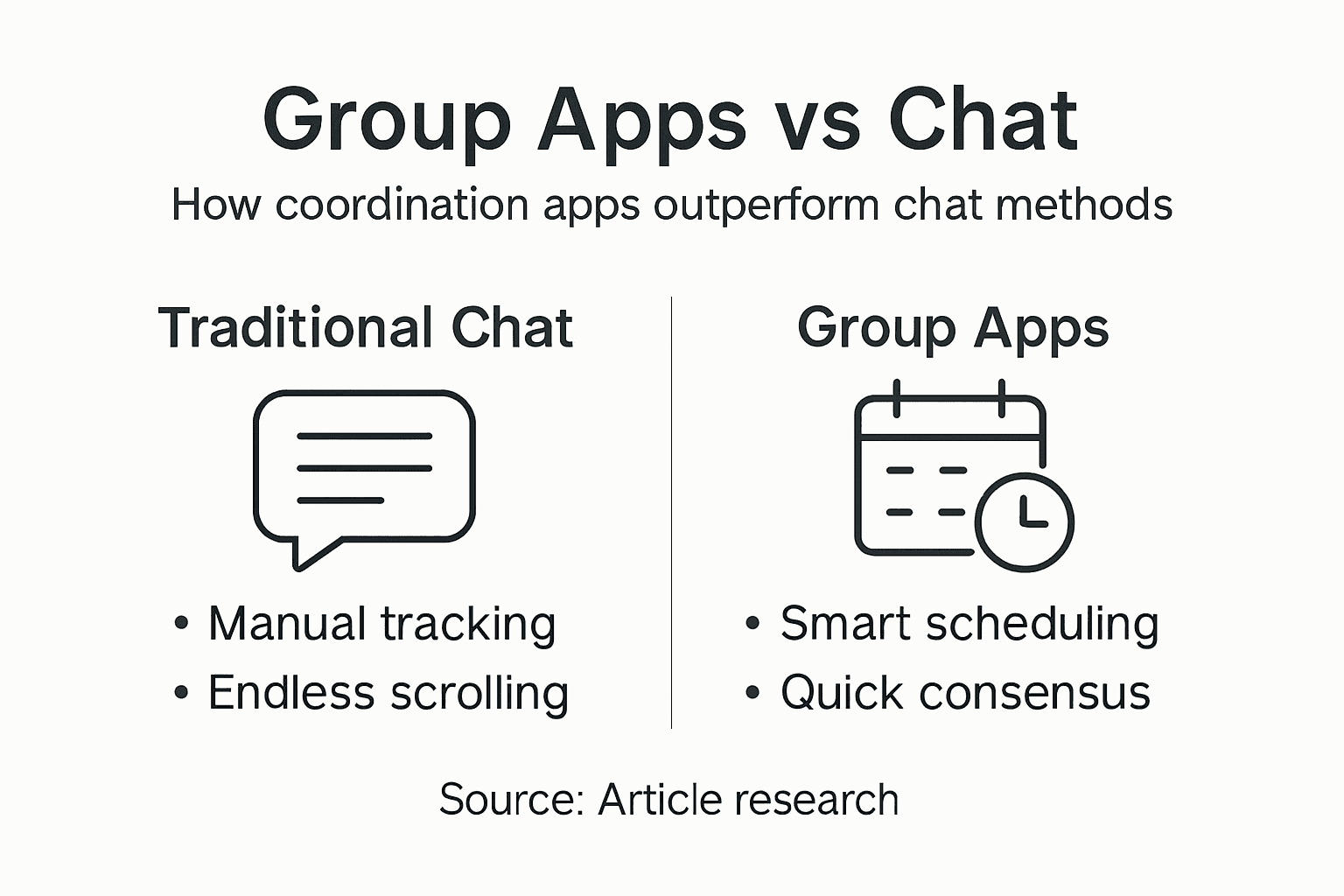
Let's clarify how group apps differ from traditional chat methods:
| Aspect | Traditional Chat Methods | Modern Group Coordination Apps |
|---|---|---|
| Scheduling Process | Manual message exchanges | Automated time suggestions |
| Decision Tracking | Relies on memory, scrolling | Context-aware progress records |
| User Experience | Chaotic, unstructured threads | Streamlined, guided workflows |
| Impact on Social Energy | Potential for planning fatigue | Minimizes stress, preserves energy |
This overview highlights why advanced group apps enhance group planning far beyond classic messaging platforms.
Pro tip: Select group apps that integrate seamlessly with your existing communication platforms to minimize adoption friction.
Mistakes to Avoid With Group Scheduling Platforms
Group scheduling platforms promise seamless coordination, but many users fall into common traps that undermine their effectiveness. Common scheduling mistakes disrupt group planning, creating frustration and reducing the tool's potential to streamline social interactions.
Critical mistakes to avoid with group scheduling platforms include:
- Ignoring individual availability constraints
- Failing to set clear planning boundaries
- Overcomplicating scheduling processes
- Neglecting real-time communication features
- Not establishing group decision-making protocols
- Resisting platform learning curves
Scheduling Platform Pitfalls emerge when users treat these tools as simple messaging apps instead of sophisticated coordination systems. Many groups make the fundamental error of using these platforms passively, without establishing clear expectations or understanding their full capabilities. The most effective platforms require active engagement and a collective commitment to streamlined planning.
Technology should simplify social coordination, not create additional complexity. Successful groups approach scheduling platforms as collaborative tools that require mutual understanding and consistent usage. By recognizing potential mistakes and proactively addressing them, friends and colleagues can transform these platforms from potential sources of frustration into powerful social planning assets.
Here's a quick summary of common user mistakes and their consequences:
| Mistake | Typical Outcome | How to Prevent |
|---|---|---|
| Overcomplicating workflows | User frustration increases | Keep processes straightforward |
| Ignoring tech learning curve | Missed potential features | Invest time for skill-up |
| Neglecting group dynamics | Planning becomes rigid | Discuss preferences regularly |
Avoiding these pitfalls boosts scheduling efficiency and supports stronger group collaboration.
Pro tip: Invest time in understanding your group scheduling platform's features before launching a complex planning initiative.
Simplify Your Social Plans with Grooop for Hassle-Free Group Coordination
The challenge of stress-free group planning highlighted in the article is all too familiar. Endless back-and-forth messages, confusing polls, and scheduling conflicts drain your social energy and make coordination a chore rather than a joy. Grooop understands these pain points by providing a lightweight scheduling tool that prioritizes quick availability matching, conflict surfacing, and natural group decision-making. This means you spend less time negotiating and more time enjoying genuine moments with your friends or small social squads.
Grooops easy-to-use platform aligns perfectly with the article’s focus on reducing planning friction and preserving social vibes. With features designed to keep the scheduling process relaxed and efficient, such as automated availability lining up and simple choice offerings, Grooop turns chaotic chats into streamlined workflows. Ready to transform your group planning experience into something stress-free and fun?
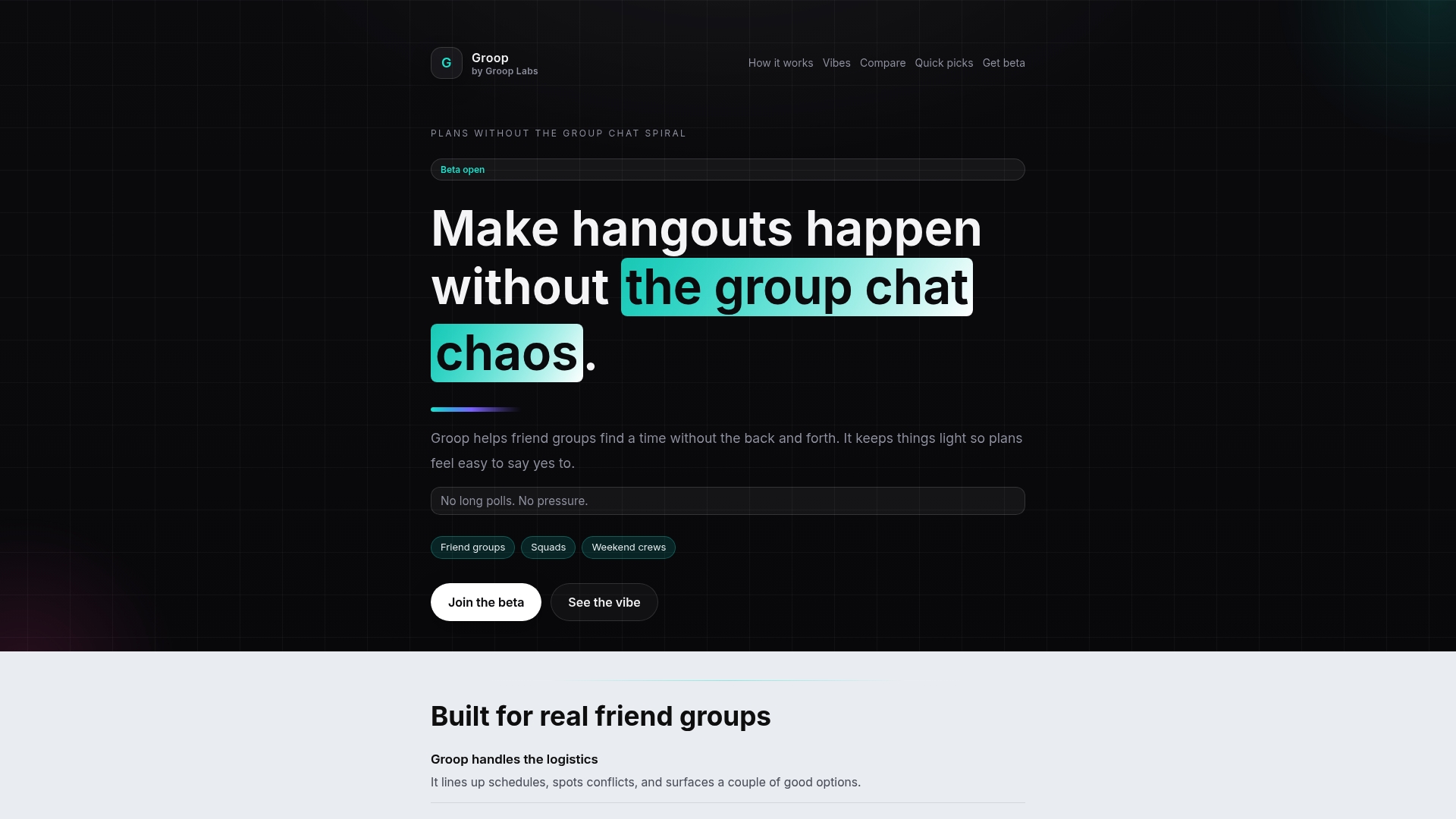
Discover how you can eliminate planning fatigue today by trying Grooop. Visit Grooops landing page to start your next hassle-free plan. Learn more about how Grooop champions intelligent scheduling and effortless social coordination at Grooops official website. Take the first step and experience group planning made truly easy and enjoyable.
Frequently Asked Questions
What are hassle-free group apps?
Hassle-free group apps are specialized platforms designed to simplify social planning, moving beyond basic messaging tools to provide intelligent coordination features, reducing planning stress and enhancing interactions among friends and colleagues.
How do group scheduling tools enhance social planning?
Group scheduling tools enhance social planning by automating time zone conversions, offering integrated availability matching, and providing built-in voting and consensus mechanisms, effectively streamlining the decision-making process.
What mistakes should I avoid when using group scheduling platforms?
Common mistakes include ignoring individual availability constraints, overcomplicating scheduling processes, and neglecting effective real-time communication features. Establishing clear planning boundaries and decision-making protocols is essential for successful use.
How do modern group apps compare to traditional chat methods?
Modern group apps offer automated scheduling capabilities, integrated calendar synchronization, and intelligent conflict resolution, transforming chaotic communication into structured planning experiences, thereby preserving social energy that would otherwise be exhausted by manual coordination.