Articles
Group Planning Apps Cut 70% Stress for Friends in 2026
Discover which group planning app cuts coordination stress by 70% for friend groups in 2026. Compare Grooop, Doodle, Facebook Events, and calendar apps to find your perfect match.

Group Planning Apps Cut 70% Stress for Friends in 2026

Coordinating hangouts shouldn't feel like a second job. Between endless message threads, conflicting schedules, and poll fatigue, planning a simple get-together can drain the fun out of socializing before it even starts. The good news? The right group planning app can slash that coordination chaos by up to 70%, giving you more time to actually enjoy your friends. This guide breaks down the types of apps available, what makes each one tick, and how to match the perfect tool to your group's size and vibe.
Table of Contents
- How To Choose The Right Group Planning App: Key Selection Criteria
- Popular Group Planning Apps For Casual Social Use
- Summary Comparison And Situational Recommendations
- Discover Hassle-Free Group Planning With Grooop
- Frequently Asked Questions About Group Planning Apps
Key Takeaways
| Point | Details |
|---|---|
| Group size drives app choice | Small groups thrive with automated tools, medium groups benefit from polling, large groups need robust platforms. |
| Scheduling method matters | Automated lineup apps reduce message volume drastically compared to manual polling or chat coordination. |
| Ease of use tops priorities | 65% prioritized scheduling speed and 58% ease of use as critical factors for casual social planning. |
| Free options exist for students | Many apps offer free tiers suitable for budget-conscious college groups without sacrificing core features. |
| Platform integration boosts adoption | Apps that sync with existing social networks or calendars see higher engagement and smoother coordination. |
How to Choose the Right Group Planning App: Key Selection Criteria
Picking the right app starts with understanding what actually matters when you're trying to rally your crew. Speed and simplicity sit at the top of the list. College students and casual groups ranked scheduling speed and ease of use as their top two factors, and for good reason. The faster you can lock in a plan, the less time spent in limbo.
Your group's size shapes which app will work best. Small squads of 3 to 8 people benefit from automated availability matching that cuts through the noise. Medium groups of 5 to 15 often need polling flexibility to balance everyone's input. Larger crews require more structured platforms with invitation management and tracking.
Scheduling method is another dealbreaker. Polling apps ask everyone to vote on options, which works well for groups that want democratic input but can drag on with too many choices. Automated lineup tools surface conflicts instantly and present a few clear options, saving you from endless back-and-forth.
Price sensitivity is real, especially for students. Many solid apps offer free tiers with enough functionality for casual social use. Premium features like calendar syncing or advanced analytics rarely matter for weekend hangouts or study sessions.
Integration with platforms you already use matters more than you'd think. If your group lives in a messaging app or social network, an app that plugs into that ecosystem will see better adoption. Understanding the key features of group chat apps helps you spot which tools will mesh with your existing communication style.
Pro Tip: Prioritize apps with three steps or fewer to finalize a plan. Any more friction and you'll find yourself back in the group chat doing it manually.
Popular Group Planning Apps for Casual Social Use
Let's break down the main players and what each one brings to the table for casual friend groups and college students.
Doodle remains one of the most recognized polling apps worldwide. Doodle uses polling to find common times and serves more than 30 million users globally, making it a safe bet for medium-sized groups. You create a poll with multiple time options, send the link, and participants mark their availability. The visual grid makes it easy to spot overlaps.

The upside? It's straightforward and works across devices without requiring app downloads. The downside? With more than five or six people, polls can become cluttered and still require someone to make the final call. It's free for basic use, with premium tiers adding features like calendar integration and ad removal.
Grooop takes a different approach designed specifically for small friend groups. Instead of asking everyone to vote, Grooop reduces scheduling message volume by up to 70% with automated lineup matching for groups of 3 to 8 people. You start a plan, the app automatically lines up availability from calendars or quick input, surfaces conflicts, and presents a few clear choices.
This method shines when you want to skip the poll fatigue and just get something locked in. It keeps the vibe relaxed because no one feels pressured to pick from 15 options or engage in endless discussion. The app is free for casual use, making it budget-friendly for students. The tradeoff is it's optimized for smaller groups, so larger crews might hit limitations.
Facebook Events leverages the social network's massive reach. Facebook Events has 700 million monthly users but offers limited conflict resolution when scheduling, according to Meta's 2025 report. If your group already hangs out on Facebook, creating an event is dead simple. You set a date, invite people, and track RSVPs all in one place.
The convenience is unbeatable for groups active on the platform. However, it lacks detailed scheduling tools to handle conflicts or find optimal times. It's more about broadcasting an event than collaboratively finding when everyone can make it. Best for situations where the date is already decided or the group is flexible.
Calendar apps like Google Calendar and Apple Calendar offer shared event features but require more manual coordination. You create an event, share it, and hope everyone checks their calendar and responds. Apple Calendar is used by 55% of iPhone users but scores low on reducing group decision friction compared to dedicated social planning apps.
These tools work fine for simple recurring events or when one person is clearly organizing. They fall short when you need to find a time that works for multiple people with busy schedules. No built-in conflict detection or option comparison means you're back to text threads or polls.
Other noteworthy options include:
- Calendly: Primarily for one-on-one or small professional meetings, with a free tier and simple interface. Less ideal for casual group social planning.
- Microsoft Outlook Meeting Polls: More common in academic or work settings, offering polling within email workflows. Feels formal for weekend hangouts.
- When2meet: A no-frills web tool popular with students for its simplicity. Participants fill in a grid of availability, and the app highlights overlaps. Free but basic, with no mobile app.
Each app's strengths and limitations become clearer when you consider your group's specific needs and habits. The overview of group chat app features provides deeper context on what to look for beyond just scheduling.
"The best group planning app is the one your friends will actually use without complaining. Simplicity wins every time."
Summary Comparison and Situational Recommendations
Here's a side-by-side look at how the main apps stack up across the factors that matter most for casual social planning.
| App | Pricing | Best Group Size | Scheduling Method | Platform Integration |
|---|---|---|---|---|
| Grooop | Free (casual use) | 3-8 people | Automated lineup | Mobile app, calendar sync |
| Doodle | Free basic, premium tiers | 5-15 people | Polling | Web, email, basic calendar |
| Facebook Events | Free | Any size | Manual date setting | Facebook ecosystem |
| Apple Calendar | Free (iOS users) | Any size | Manual coordination | Apple devices, iCloud |
| Google Calendar | Free | Any size | Manual coordination | Google ecosystem |
| When2meet | Free | 5-12 people | Availability grid | Web only |
For small, tight-knit friend groups or siblings planning spontaneous hangouts, Grooop's automated approach minimizes the coordination tax. You're not asking everyone to weigh in on 10 different time slots or sift through a message thread to find common ground. The app does the heavy lifting and presents a few solid options.
Medium groups that value democratic input but still want efficiency should lean toward Doodle. It strikes a balance between gathering everyone's preferences and keeping the process manageable. Just be mindful of poll fatigue if you're coordinating weekly.
Groups already living on Facebook benefit most from Facebook Events for its zero-friction invites and built-in social context. It's perfect when the date is set and you're just tracking who's coming, less so for finding that date in the first place.
For groups where everyone uses iPhones and Apple devices, Apple Calendar shared events offer a native option. The experience feels seamless within the ecosystem, though it requires more manual back-and-forth than dedicated planning apps.
Think about your typical planning scenario. Are you trying to schedule a one-off road trip with six friends? Grooop's quick conflict resolution saves time. Planning a monthly study group with rotating availability? Doodle's polling gives everyone a voice. Organizing a birthday party where the date is already decided? Facebook Events broadcasts it efficiently.
Pro Tip: Start with your group size as the filter, then narrow by whether you want automated matching or democratic polling. Integration preferences and budget come last because most apps are free for basic use.
For more guidance on managing group dynamics during planning, check out the friend group coordination explained resource.
Discover Hassle-Free Group Planning with Grooop
If you're tired of watching your group chat explode every time someone suggests getting together, Grooop offers a refreshing alternative. Built specifically for small friend groups and college students, it automates the tedious parts of scheduling so you can focus on the fun.
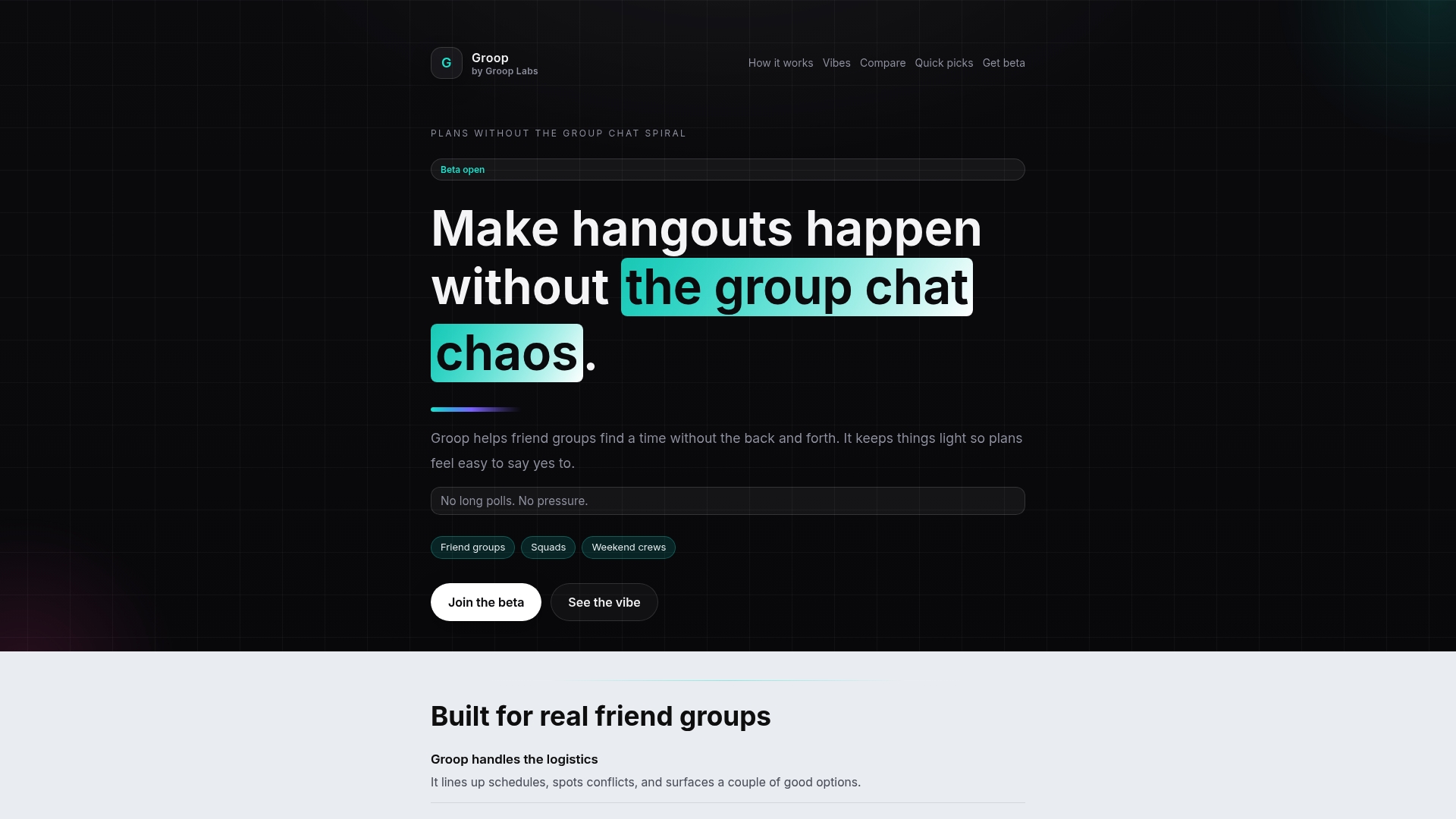
Grooop's automated availability lineup cuts message volume by up to 70%, meaning fewer notifications and faster decisions. The app keeps your group's vibe intact by presenting clear, pressure-free options that feel natural to accept. It's free for casual social use, making it accessible for budget-conscious students.
Explore the Grooop app to see how lightweight scheduling can transform your social coordination. For practical tips on maximizing your planning efficiency, dive into group event planning tips and learn about the benefits of small group planning on the Groop Blog.
Frequently Asked Questions About Group Planning Apps
What is the easiest group planning app for small friend groups?
Grooop is designed specifically for small groups of 3 to 8 people, automating availability matching to reduce message overload by up to 70%. Its minimal-step workflow and clear options make it the simplest choice for casual social planning without polls or complex features.
How do polling-based scheduling apps work?
Polling apps like Doodle present multiple time options that participants mark as available or unavailable. The organizer reviews the results to identify overlaps and selects the time that works for the most people. This method balances democratic input with coordination efficiency for medium-sized groups.
Can I use calendar apps like Apple Calendar for group events?
Yes, but calendar apps require manual coordination since they lack built-in conflict detection or option comparison. You'll need to create a shared event and rely on message threads to find a time everyone can make, which can be time-consuming for busy groups.
Are there free group planning apps suitable for students?
Grooop, Doodle, When2meet, and Facebook Events all offer free tiers with core scheduling features perfect for student budgets. These apps provide enough functionality for casual social planning without requiring premium subscriptions, though some limit advanced features like calendar syncing.
How to reduce message overload when planning with friends?
Switch from open-ended group chat coordination to an app with automated availability matching or structured polling. Apps like Grooop surface conflicts and present clear options, eliminating endless back-and-forth. The friend group coordination guide offers more strategies to streamline your planning process and keep everyone on the same page.
Recommended
- 7 Essential Group Event Planning App Tips for 2026 | Groop Blog
- Hassle-Free Group Apps: Stress-Free Social Planning | Groop Blog
- Top 7 Group Planning App Picks to Simplify Team Events 2026 | Groop Blog
- Why Streamline Friend Hangouts: Less Stress, More Fun | Groop Blog
- Web App Design Workflow: 60% Cost Reduction with Agile Steps
- Siift: Solving Founder Problems in 2026