
Articles
Master social scheduling to simplify your group plans
Discover what social scheduling is and how it eliminates the chaos of coordinating casual hangouts. Learn practical tips to plan group events faster with less hassle and more fun.

Master social scheduling to simplify your group plans

You know the drill: someone suggests hanging out, and suddenly your group chat explodes with dozens of messages trying to find a time that works. Half the group doesn't respond, someone misses the thread entirely, and by the time you finally pick a date, two people can't make it anymore. This chaos has a simple solution: social scheduling. This article breaks down what social scheduling is, why it beats endless texting, and how you can use it to plan your next hangout without the headache.
Table of Contents
- Key takeaways
- What is social scheduling? A simple tool for group plans
- Why social scheduling matters: common planning struggles it solves
- Comparing group scheduling methods: chats, polls, and tools
- How to use social scheduling for your next casual hangout
- Simplify your social plans with Groop's scheduling tools
- Frequently asked questions
Key Takeaways
| Point | Details |
|---|---|
| Centralized responses | Everyone's availability is gathered in one place, reducing miscommunication and scattered planning. |
| Real time updates | Status updates appear as people mark availability, keeping the group aligned without endless threads. |
| Faster planning | Social scheduling tools cut planning time significantly compared to unstructured group chat coordination. |
| Quick consensus | The system highlights slots with the most availability to help the group reach a clear decision quickly. |
What is social scheduling? A simple tool for group plans
Social scheduling is exactly what it sounds like: a method for coordinating social events that collects everyone's availability and displays it in one clear view. Instead of scrolling through endless messages trying to remember who said they're free Saturday versus Sunday, you get a straightforward snapshot of when most people can meet.
Think of it as the difference between asking each friend individually about their schedule versus sending out a quick poll everyone can answer in seconds. The tool does the heavy lifting of comparing responses and highlighting the times that work for the majority. No spreadsheets, no mental math, no confusion.
Most social scheduling happens through apps or simple online tools designed specifically for casual event planning. These platforms let you propose multiple time options, invite your group, and watch as responses come in. The system automatically identifies conflicts and shows you which slots have the most availability.
Here's what makes social scheduling different from regular planning:
- Everyone sees the same information simultaneously, eliminating miscommunication
- Responses are structured and easy to compare at a glance
- The tool handles the logistics so you can focus on the fun parts
- Updates happen in real time as people mark their availability
- You get a clear winner without having to manually tally votes
The beauty of social scheduling lies in its simplicity. You're not learning complex software or forcing your friends to adopt corporate-style calendar systems. It's just a smarter way to answer the question: when can we all hang out?
Why social scheduling matters: common planning struggles it solves
Planning casual meetups shouldn't feel like project management, but traditional group chat coordination often does. You've probably experienced the classic pattern: someone floats an idea, enthusiasm builds, then the logistics nightmare begins. Messages pile up faster than anyone can read them, creating a chaotic thread where important details get buried.
The problems multiply quickly. Time zone confusion happens even when everyone's local. People respond to outdated suggestions because they didn't see the five messages that came after. Someone proposes a time that three people already said doesn't work. The conversation fragments into side threads and direct messages, scattering information across multiple places.

Misunderstandings are practically guaranteed in this environment. Did Sarah say she's free Friday or that Friday doesn't work? Is 7pm too late for the people who have early shifts? By the time you think you've reached consensus, half the group has mentally checked out from decision fatigue.
Social scheduling cuts through this mess by providing structure without formality. Research shows that scheduling friend meetups with dedicated tools can reduce planning time by 67% compared to unstructured group chat coordination. That's not a small improvement; it's transformative.
Here's how social scheduling solves the biggest pain points:
- Centralizes responses: Everyone's availability lives in one place instead of scattered across dozens of messages
- Eliminates redundant questions: The tool shows what's already been answered, so people stop asking the same things repeatedly
- Surfaces conflicts immediately: You see scheduling problems right away instead of discovering them after you've committed to a plan
- Maintains engagement: People can respond quickly without reading through long threads, keeping everyone involved
- Creates accountability: When availability is visible to the group, people are more likely to give accurate responses
The common challenges in group scheduling stem from information overload and lack of structure. Social scheduling tools address both by organizing responses and presenting them clearly.
Pro Tip: Set a deadline for responses when you create a social schedule. Giving people 24-48 hours to mark their availability creates urgency without pressure, ensuring you get answers before momentum fades.
Comparing group scheduling methods: chats, polls, and tools
Not all planning methods are created equal. Understanding the differences helps you choose the right approach for your group and situation. Let's break down the three most common ways people coordinate social plans and see how they stack up.
Group chats are where most planning starts. They're convenient because everyone's already there, and the conversation feels natural. But that convenience comes with serious drawbacks. Messages arrive out of order, responses get buried, and there's no easy way to see the overall picture. You end up with a messy thread where finding key information requires scrolling back through jokes, memes, and off-topic tangents.
Simple polls represent a step up in organization. They give structure to responses and make it easier to count votes. However, most basic poll tools lack context. You can see that seven people prefer Saturday, but you don't know if those seven include the birthday person whose celebration you're planning. Polls also tend to be static; if someone's plans change, updating becomes awkward.
Dedicated social scheduling tools combine the best aspects of both approaches while eliminating their weaknesses. They provide the structure of polls with the flexibility and context of conversation. According to research on group chat versus scheduling tools, dedicated platforms dramatically reduce confusion and accelerate decision making by presenting information more effectively.
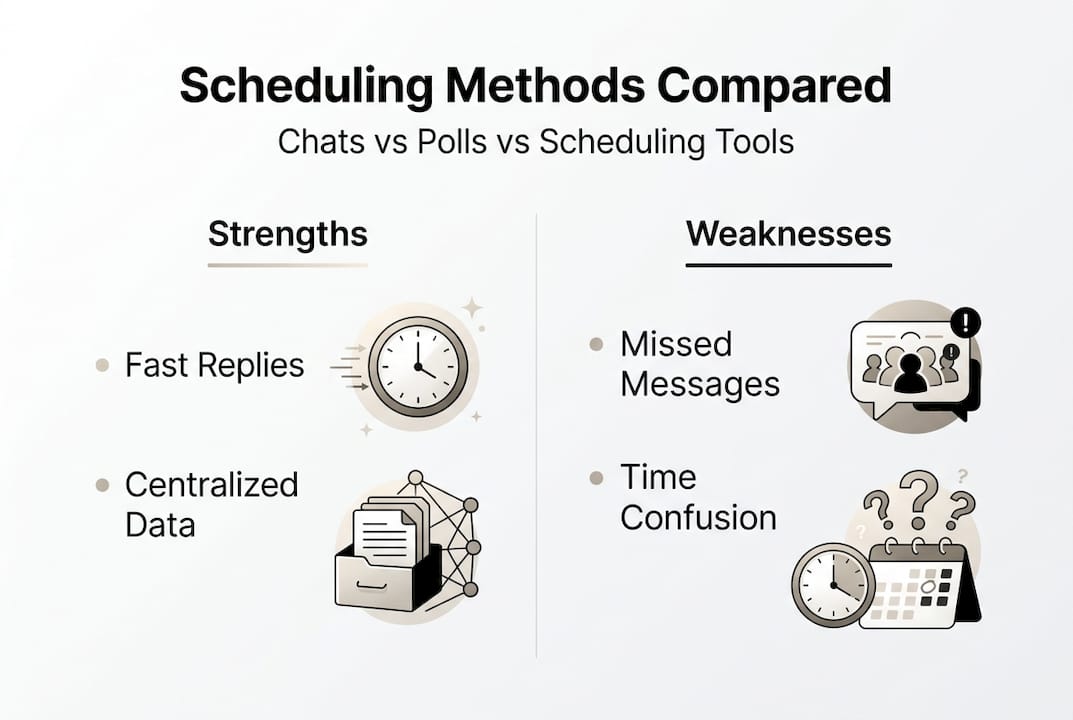
| Method | Ease of use | Speed | Clarity | Consensus building |
|---|---|---|---|---|
| Group chat | High (everyone has it) | Slow (lots of back and forth) | Low (info scattered) | Difficult (no clear winner) |
| Simple polls | Medium (need separate tool) | Medium (one round of voting) | Medium (shows votes only) | Moderate (majority visible) |
| Social scheduling tools | High (designed for this) | Fast (real-time updates) | High (structured display) | Easy (automatic highlighting) |
The advantages of dedicated social scheduling tools become obvious when you use them:
- Real-time updates mean everyone sees changes immediately without refresh delays
- Conflict detection happens automatically, flagging problems before they derail plans
- Integration with calendars eliminates manual date entry and reduces errors
- Participation tracking shows who hasn't responded yet, making follow-up easier
- Historical data helps you learn patterns about when your group is typically free
For casual hangouts with close friends, any method can technically work. But as group size increases or scheduling complexity grows, the limitations of chats and basic polls become frustrating. Social scheduling tools scale effortlessly from small gatherings to larger events without adding mental overhead.
How to use social scheduling for your next casual hangout
Ready to ditch the planning chaos? Getting started with social scheduling is straightforward, and you'll see benefits immediately. Follow this process to coordinate your next group activity with minimal hassle.
First, choose a platform that fits your group's style and technical comfort level. Look for tools designed specifically for social coordination rather than business meetings. The interface should be intuitive enough that friends can respond without instructions. Most importantly, pick something that works on mobile since that's where your group likely communicates.
Once you've selected your tool, create your event and propose multiple time options. Don't just suggest one time and hope it works. Offer three to five different slots across different days or times of day. This flexibility dramatically increases the chances of finding a time that works for most people. Include key details like location and activity so everyone has context when marking availability.
The implementation process looks like this:
- Set up your event: Add a clear title, description, and proposed times that span different days or time blocks
- Invite your group: Share the scheduling link through your usual communication channel, whether that's group chat, social media, or direct messages
- Monitor responses: Watch as friends mark their availability and the tool highlights which times work best
- Make the call: Once you have enough responses (aim for at least 70% of the group), select the time with the most availability
- Confirm and share: Send a final message with the chosen time, location, and any other important details
- Follow up: A day before the event, send a quick reminder to keep attendance high and give people a chance to raise last-minute conflicts
The step-by-step approach to group scheduling emphasizes clear communication at each stage. Don't assume people will check the tool multiple times. Send updates when you create the schedule, when responses are due, and when you finalize plans.
Pro Tip: When proposing times, consider your group's typical patterns. If everyone works 9-5, suggesting a Tuesday lunch probably won't work. Think about when people are genuinely free and relaxed, not just technically available.
The key to success is making participation effortless. The easier you make it for friends to respond, the faster you'll reach consensus. Keep your event description concise, limit the number of time options to avoid decision paralysis, and set clear expectations about when you need responses.
Simplify your social plans with Groop's scheduling tools
Tired of the planning runaround? Groop takes everything we've discussed and packages it into a mobile app built specifically for friend groups like yours. The platform shows everyone's availability instantly, surfaces conflicts before they become problems, and helps you pick meeting times that actually work for your squad.
Groop eliminates the message overload that typically bogs down group planning. Instead of endless back-and-forth texts, you get a clean interface that makes coordination feel natural and pressure-free. The app maintains your group's vibe while handling the logistics that usually create friction. Whether you're planning a study session, weekend adventure, or casual hangout, Groop's social scheduling tools cut through the chaos so you can focus on having fun instead of coordinating calendars. Try it for your next get-together and experience how much easier planning becomes when everyone's on the same page.
Frequently asked questions
What exactly is social scheduling?
Social scheduling is a coordination method that collects and displays group members' availability in one centralized place, making it easy to find times that work for everyone. Unlike traditional group chat planning where information gets scattered across dozens of messages, social scheduling uses structured tools or apps to organize responses clearly. It's designed specifically for casual social events rather than formal business meetings, keeping the process relaxed and straightforward.
How is social scheduling different from just using group chat?
Group chats mix planning logistics with regular conversation, making it hard to track who's available when. Social scheduling separates coordination into a dedicated space where responses are structured and easy to compare. While group chats require you to scroll through messages and mentally compile everyone's answers, scheduling tools automatically highlight the best times and show conflicts immediately. The difference is like comparing a messy pile of sticky notes to a organized checklist.
How do I get my friends to actually use scheduling tools?
Start by choosing a tool that's dead simple and mobile friendly, since complicated platforms will get ignored. When you share the scheduling link, explain briefly why it's easier than the usual message chaos, focusing on how it saves everyone time. Lead by example by using it consistently for your group's plans, and people will adopt it once they see how much smoother coordination becomes. Most resistance comes from unfamiliarity, which disappears after one or two successful uses.
What are common mistakes people make when planning group events?
The biggest mistake is proposing only one time option and hoping everyone's free, which almost never works for groups larger than three people. Other errors include waiting too long to finalize plans (momentum fades fast), not sending reminders before the event, and failing to confirm who's actually coming versus who just said "maybe." People also frequently forget to specify important details like exact location or whether the plan is indoor or outdoor, leading to confusion and last-minute scrambling.
Why is social scheduling especially helpful for busy young adults?
Young adults typically juggle multiple commitments including work, school, side projects, and other social obligations, making spontaneous coordination nearly impossible. Social scheduling respects everyone's time by providing quick visibility into when people are genuinely free, eliminating the guilt and frustration of endless rescheduling. It also reduces the mental load of tracking multiple conversations and remembering who said what, which matters when you're already managing a packed schedule. The efficiency gain means more actual hangout time and less time spent trying to make hangouts happen.