
Articles
Why Group Chats Need Organization for Stress-Free Plans
Discover why group chats need organization, the problems of unstructured planning, how streamlined tools help, and ways to maintain a fun vibe.

Why Group Chats Need Organization for Stress-Free Plans

Anyone who’s ever tried to organize dinner with friends knows how quickly group chats spiral into confusion. Plans get buried in a flood of messages, people miss important details, and the original idea fizzles out. For social squads and student groups, getting everyone on the same page feels impossible without group chat organization. Studies confirm that clear structure and purpose in group chats lower stress and make planning smoother for everyone. Learn how simple coordination methods turn group chaos into fun, stress-free hangouts.
Table of Contents
- Defining Group Chat Organization And Its Importance
- Chaos And Miscommunication Without Structure
- How Organizational Tools Transform Group Chats
- Balancing Flexibility With Social Group Vibes
- Avoiding Common Pitfalls In Group Coordination
Key Takeaways
| Point | Details |
|---|---|
| Importance of Organization | Organized group chats enhance decision-making speed and reduce stress levels, fostering more enjoyable interactions. |
| Clarity in Communication | Clearly defined roles and expectations within group chats prevent confusion, ensuring that everyone knows how to contribute. |
| Shared Responsibility | Distributing planning responsibilities among all members prevents burnout and promotes equitable participation in decision-making. |
| Flexibility with Structure | Establishing a simple organizational framework allows for spontaneity, enabling the group to execute last-minute hangouts effortlessly. |
Defining Group Chat Organization and Its Importance
Group chat organization sounds like a boring administrative task, but it's actually the difference between plans that happen and plans that fade into oblivion. When you send "let's grab dinner this Friday" into a group chat with ten people, chaos follows. People respond at different times. Someone misses the message entirely. Another person suggests a completely different time. By the time you've scrolled through 47 messages, nobody remembers what the original plan was, and Friday dinner never happens.
At its core, group chat organization means establishing clear structure, purpose, and guidelines for how your friend group communicates and makes decisions together. It's not about rigid rules that kill the vibe. Instead, it's about creating just enough framework that everyone knows what's happening, when decisions need to be made, and how to find information quickly. Research into organized group communication shows that structured group chats reduce stress, enhance engagement, and actually help people coordinate better without the constant back-and-forth anxiety. When your group has organization, members feel less overwhelmed by notifications, more confident about plans, and genuinely excited to show up because everyone's on the same page.
Why does organization matter specifically for planning? Because unorganized group chats create decision paralysis. You ask "who's free Saturday?" and get responses scattered across three different conversations, with some people saying they're free but not confirming, others asking "free for what?" and one person accidentally replying to an old message from last month. The planning process that should take five minutes takes two hours, multiple follow-up messages, and leaves you stressed before the hangout even starts. Studies reveal that formal structure in group chats, including clarity about purpose and protocols, maximizes communication efficiency while significantly reducing the emotional drain of coordinating with multiple people simultaneously. When friend groups establish clear communication standards, they naturally spend less mental energy on logistics and more on actually enjoying time together.
Organization also preserves your group's social energy. Without structure, someone always ends up being the "organizer" who relentlessly tracks everyone down, sends reminder after reminder, and ultimately feels resentful. With organization, responsibility gets distributed. People know they need to respond by a certain time, they see clear options instead of open-ended questions, and decision-making becomes collaborative rather than one person pushing the group forward. This creates a healthier dynamic where planning feels like something the group does together, not something done to them.
Here's a comparison of group chat dynamics with and without organization:
| Aspect | Organized Group Chat | Unorganized Group Chat |
|---|---|---|
| Decision-making speed | Fast and straightforward | Slow and confusing |
| Stress levels | Lower due to clarity | Higher from chaos |
| Participation | Evenly distributed | Organizer burnout is common |
| Social energy | Preserved for fun | Drained by logistics |
Pro tip: Start by asking your group one simple question: "What makes planning frustrating for you?" Their answers will show you exactly what organization you actually need, rather than implementing systems nobody uses.
Chaos and Miscommunication Without Structure
Picture this: You send a message at 2 PM asking if everyone can do dinner Friday. By 3 PM, you have 23 new messages. Sarah says yes but didn't see the part about Friday and thought you meant Wednesday. Marcus replied to a message from three weeks ago about something completely different. Two people just reacted with thumbs up emojis and nothing else. Someone sent a long paragraph about why they can't make it, but buried in the middle is actually a "yes if it's after 7." Now you're scrolling endlessly, trying to piece together who's actually coming, and honestly, you've kind of lost interest in dinner altogether.

This is what happens when group chats lack organization. Without clear structure, information overload and missed messages become inevitable. People struggle to find relevant information in the noise. Someone shares an idea, three people don't see it, and the same suggestion gets repeated five times. Nobody knows if a decision has been made or if the conversation is still ongoing. The chat becomes a place where important details get buried under tangential conversations, jokes, and reactions. What should be a quick coordination tool transforms into something that actually makes planning harder.
The real cost of unstructured group chats goes beyond just inconvenience. Research shows that poorly managed communication protocols create emotional stress and confusion. When people can't find information, they feel anxious about whether they're missing something crucial. When messages get lost, they worry that others think they're flaky or unreliable. One person ends up frustrated because they've asked "so are we doing this or not?" five times and still doesn't have a clear answer. Another person feels overwhelmed by constant notifications and stops checking the chat altogether, which means they miss the actual plan. The group's trust erodes slightly each time someone shows up late because they didn't see the time change, or doesn't show up at all because they thought it got canceled. Miscommunication creates a ripple effect that damages both the plans and the friendships.
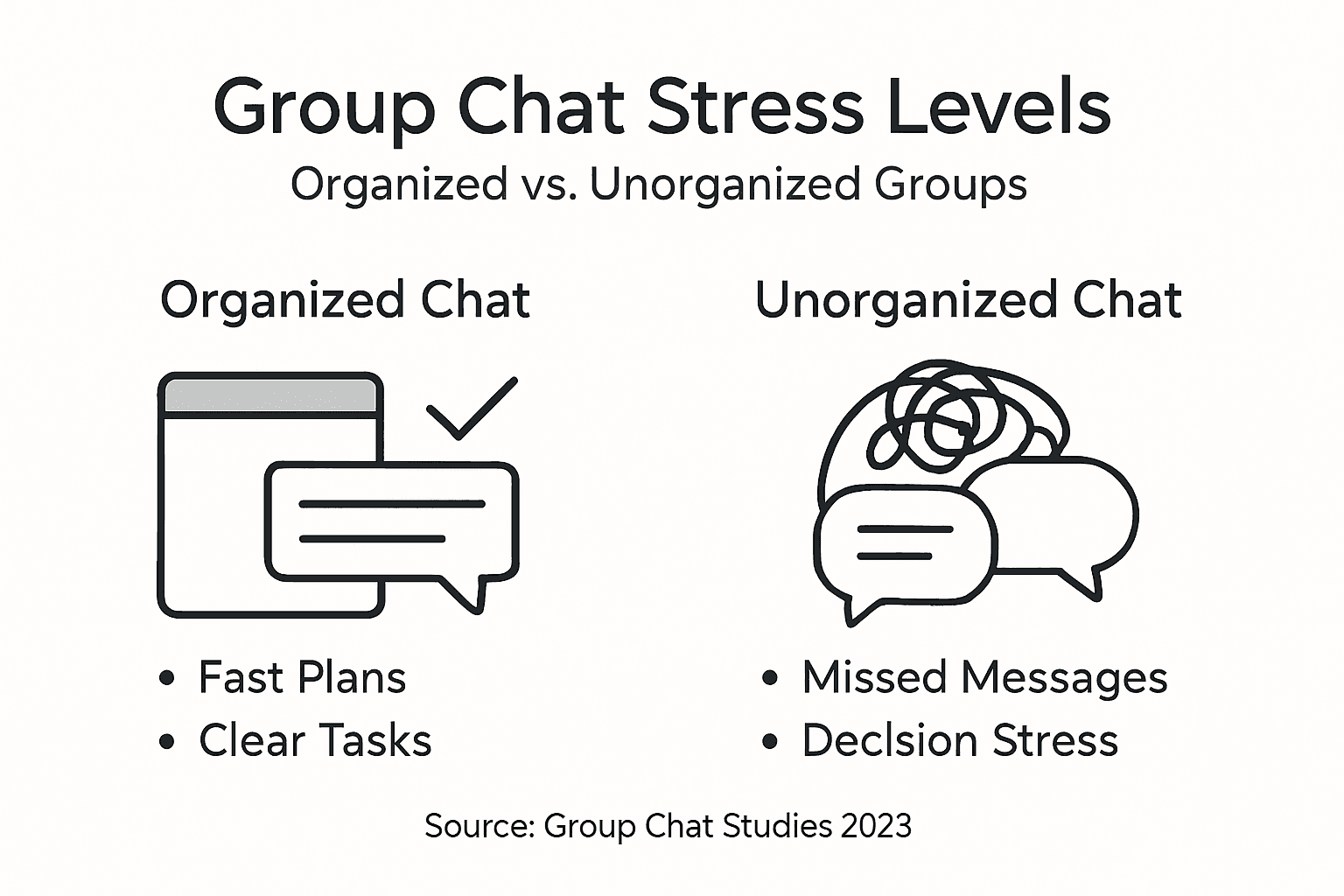
Without structure, planning also becomes exhausting for whoever takes charge. One person naturally becomes the unofficial organizer. They send clarifying messages, they hunt down responses, they consolidate information, they send reminders. They do this repeatedly because nothing sticks the first time. Over time, this person feels used. They're doing emotional labor that nobody asked them to do, and nobody recognizes because it's happening invisibly in a chaotic chat. Eventually, they stop organizing, and plans either fall apart or everyone looks around wondering why nothing ever happens anymore. The chaos isn't just inefficient. It's emotionally draining. It creates resentment. It makes people less likely to suggest hangouts in the future because they anticipate the headache.
Pro tip: Before organizing a plan, send one message that clearly states what you're deciding, when you need a response, and what the options are, then wait for replies before sending follow-ups.
How Organizational Tools Transform Group Chats
Here's where things shift. When you introduce the right organizational approach to your group chat, everything changes. Instead of scrolling through 47 messages to find out if dinner is happening, you see a clear proposal with three time options and a deadline for responses. Instead of asking "did anyone see my message about the location?" you know everyone has access to the same information in one place. Instead of one person burning out from coordinating, the whole group participates in a structured process that takes minutes instead of hours.
Organizational tools work by doing something simple but powerful: they separate the social conversation from the logistical decision-making. Your group chat stays fun and casual for jokes and banter, but planning gets its own dedicated space with clear structure. Centralized task management and real-time updates dramatically reduce miscommunication because everyone sees the same information simultaneously. When someone proposes a plan, there's no ambiguity about what's being decided. People can see exactly what options exist, when they need to respond, and what the status is. If someone misses the initial message, they can catch up without asking three different people what's happening. The chaos doesn't disappear because someone suddenly got organized. It disappears because the tool removes the gaps where miscommunication lives.
Consider what happens with structured planning in your group. You propose dinner Friday and present it clearly: three restaurant options, three time slots, deadline for responses by Wednesday evening. People respond once with their preference. The tool tracks who's responded and who hasn't. By Wednesday evening, you have clarity. You can see that 6 out of 8 people want the Italian place at 7 PM. You send one confirmation message. Done. That entire process took maybe five total minutes of actual engagement. Without structure, that same decision would take three days, 50 messages, multiple follow-ups, and still leave someone confused about timing or location. The difference isn't willpower or better friends. It's the structure itself. Structured workflows and unified communication channels naturally foster accountability because people understand what's expected and when. When friend groups implement clearer planning approaches, decisions happen faster and people feel more confident about commitments.
The transformation also relieves emotional labor from one person's shoulders. Nobody has to be the organizer anymore because the system is the organizer. Roles become clear. When you propose a plan, you're not taking on the responsibility of herding everyone. You're just presenting options and letting the tool handle tracking and clarity. People feel respected because they're not being chased down. They know what information they need, they respond when they're ready, and everything gets consolidated automatically. The whole group experiences planning as something that happens smoothly rather than something stressful that requires one person's constant attention. Over time, people actually enjoy proposing plans because they know it will go smoothly. The group dynamic shifts from "ugh, another hangout attempt" to "yeah, let's set that up."
Key organizational tools and their effects in group chats:
| Tool Type | Main Benefit | Group Impact |
|---|---|---|
| Centralized task list | Reduces repeated info | Keeps everyone updated |
| Polling features | Streamlines decisions | Ensures all voices count |
| Event reminders | Increases attendance | Avoids missed plans |
| Separate channels | Splits banter and planning | Minimizes message overload |
Pro tip: Start small: use an organizational tool for just one type of plan first (like weekly hangouts or monthly outings) to let your group get comfortable with the process before using it for everything.
Balancing Flexibility With Social Group Vibes
Here's the thing that trips up a lot of friend groups: they think organization means rigidity. They imagine having to follow strict rules, losing spontaneity, and turning hangouts into corporate meetings. So they reject organization entirely and go back to chaos. But that's a false choice. The best organized groups aren't rigid at all. They're actually more flexible because the structure removes the friction that usually kills spontaneous plans.
Think about it this way. When your group has a clear process for planning, someone can suggest a last-minute hangout at 3 PM and the group can actually pull it off. Why? Because everyone knows how to respond quickly and clearly. Without organization, that same last-minute idea gets buried in notifications, people can't find the details, someone misses the message entirely, and the whole thing falls apart. Balancing clear guidelines with adaptability actually creates more flexibility, not less. The structure handles the boring logistics so your group has mental space for spontaneity. Organization isn't about controlling your group's social energy. It's about protecting it.
The real secret is keeping the organized parts limited and specific. You don't need to organize everything. You organize the decision-making part of planning. You create a simple, clear way to ask a question, present options, and get answers. Everything else stays organic. Your group chat is still the place where you share jokes, react with emojis, have tangential conversations, and be weird together. That social energy never changes. What changes is that when someone says "let's do something Friday," there's a reliable way to make that decision without derailing the whole chat. You've separated the signal from the noise. The social vibes live in one space, logistics live in another, and your group feels better because everyone gets what they need. One person isn't exhausted from organizing. Nobody's anxious about missing information. People can actually relax and look forward to plans.
Consider how this plays out practically. Your group has a standing weekly hangout, and you've got a simple process: every Tuesday, someone proposes three time options for that week and people respond by Wednesday morning. That's it. The structure takes thirty seconds to use, and it removes all the back-and-forth. On Thursday, someone has a random idea for a spontaneous movie night tomorrow. The group can decide on it quickly because everyone already understands how to respond. Nobody thinks they're missing a message. Nobody's confused about timing. The spontaneous plan actually happens because the framework makes it possible. When friend groups avoid vague commitments, they ironically get more spontaneous moments, not fewer, because they can actually execute on impulses instead of watching them evaporate in group chat confusion.
The balance also means giving people grace. Organization doesn't mean perfection. Someone misses the planning deadline because they were busy. That's fine. Someone changes their mind about attending. That's fine too. The organization isn't there to police your friends. It's there to make planning less painful so you all have more energy for actually enjoying each other. Your group's vibe stays relaxed because the process is easy and doesn't demand more than people are willing to give.
Pro tip: Keep your organizational system absurdly simple: no more than two or three steps for proposing a plan, and make sure responding takes less than thirty seconds.
Avoiding Common Pitfalls in Group Coordination
Even when groups have good intentions about organizing, they often stumble into the same traps. You know the patterns. One person ends up coordinating everything while everyone else goes silent. Someone proposes a plan but doesn't clarify what they're actually asking. People commit to attending and then ghost without communication. Someone feels excluded from decision-making. The group spends more energy managing conflict about the plan than enjoying the plan itself. These aren't personality problems or friendship failures. They're coordination problems that happen predictably when structure is missing.
One of the biggest pitfalls is unclear roles and expectations. When you propose a hangout, make it explicit what you need from people. Are you asking them to respond by a certain time? Do you need them to choose between specific options or can they suggest alternatives? Will the group make a final decision democratically, or will you decide once you have enough responses? Establishing clear role assignments and project objectives prevents confusion and resentment. Without clarity, people don't know how to contribute. Some feel like they should be involved in every decision. Others think one person is being controlling. The same planning process that should bring the group together instead creates friction because nobody knows what's actually expected. A simple fix: when you propose something, spell out exactly what you need. "I want to do dinner Friday. I'm proposing these three restaurants and these two times. Can you pick your preference by Wednesday?" That's it. Everyone knows what's happening and what role they play.
Another common trap is uneven participation and domination by certain voices. In most friend groups, a few people do most of the organizing while others coast. The people who organize get burned out. The people coasting sometimes don't even realize it's happening. Establishing collaboration norms and encouraging equitable participation prevents this dynamic from festering. When everyone understands that participation is expected and valued equally, people step up. You could rotate who proposes plans. You could make it clear that everyone's input matters by acknowledging responses and thanking people for participating. You could invite quieter group members to suggest plans sometimes. The group works better when participation is distributed rather than concentrated in one person's hands. When friend groups establish clear hangout logistics, the planning becomes something everyone can do, not just the naturally organized people.
A third pitfall is conflict avoidance. Someone doesn't like a restaurant choice but doesn't say anything. Someone's not actually free at the proposed time but says yes anyway because they don't want to disappoint the group. Someone's frustrated that decisions always happen in the group chat when they prefer direct messages, but never speaks up. Small tensions build. People show up resentful or don't show up at all. This happens because friends don't want to create conflict, so they avoid saying what they actually need. The antidote is creating psychological safety. Let your group know that disagreement and honest feedback are welcome. If someone can't make a time, that's genuinely fine. If someone hates a restaurant idea, that's valuable information. When people feel safe saying what they actually think instead of just going along, plans become better and everyone feels more respected.
Pro tip: After your first few organized plans, ask your group one simple question: "What's one thing I could do differently next time to make planning easier for you?" Their answers will tell you which pitfalls are actually affecting your specific group.
Transform Your Group Chat Into a Stress-Free Planning Hub
Feeling overwhelmed by chaotic group chats when trying to make plans is a common struggle highlighted in the article. The endless messages, missed details, and organizer burnout drain your group's social energy and leave everyone frustrated. If you want to reduce decision paralysis, streamline communication, and preserve your friendships from the chaos of unstructured group chats, Groop offers a simple solution designed just for this challenge.
Groop is a mobile app built to help casual friend groups take control of their planning without sacrificing their vibe. With features that automatically align availability, highlight conflicts, and present clear, manageable options, Groop removes the anxiety and endless back-and-forth messages that make coordination painful. Start using Groop today to enjoy quicker decisions, shared responsibilities, and more time actually having fun together. Discover how easy stress-free plans can be by visiting Groop's home page or learn more about how we help groups stay organized at Groop Labs. Your next hassle-free hangout is just a few clicks away.
Frequently Asked Questions
Why is organization important in group chats?
Group chat organization helps establish clear structure, purpose, and guidelines, making decision-making faster and reducing stress for everyone involved. It prevents chaos and miscommunication by providing a framework for communication.
How can I encourage participation in planning within my friend group?
To encourage participation, establish clear roles and expectations for everyone. Make it clear that everyone’s input is valued, and consider rotating who proposes plans to distribute responsibility evenly.
What are some tools I can use to organize group chat plans?
Organizational tools like centralized task lists, polling features, event reminders, and separate channels can significantly enhance coordination by keeping everyone on the same page and reducing clutter in the chat.
How can I address conflicts or disagreements in group planning?
Create an environment of psychological safety in your group chat where feedback and disagreement are welcomed. Encourage open communication so that group members feel comfortable expressing their preferences and concerns.